Not the End of the World

To commemorate a safe landing from the first-ever hot air balloon ride in Cappadocia

As I write this in my hotel room in the Uchisar Kaya Hotel in Cappadocia, it is 6.01PM, 5 July (Sat) which translates to 12.01AM, 6 July (Sun) in July. The world has not ended, contrary to the original prediction from author-artist Ryo Tatsuki. But that has not lessened the impact on inbound tourism, with bookings from travelers of nearby Asian countries down by half of what had been forecasted.

I am not sure what the impact on outbound tourism is though in my case, this has more to do with taking advantage of the 2-week lull that I get to enjoy before embarking on a new job. And so 2 weeks before the planned departure, I booked a one-week trip with a major Japanese tour agency to Turkey on a whim. Heck, I didn’t even read through the itinerary once I confirmed that Cappadocia was in it.

There wasn’t any time for that even with the demands of my consulting projects and purchase and move to a new studio apartment taking place in the same month. All happening right on the heels of my sister’s wedding in Singapore at the end of May.

I’ve got a friend who put it aptly as me having more things happening in my life in these three months (May – July) than most people would have in three years. It does feel like this, and I would have liked more time to digest each of these pivotal events and give them the limelight that they deserve.

Oh, the emotions that come from

  • bearing witness and facilitating the wedding of a most beloved yonger sister
  • committing to the largest financial commitment of my life along with its geographical implications
  • bidding farewell to the job in which I earned my stripes as a consultant and forged many friendships and;
  • embracing a new corporate identity and challenge in a completely new industry

Indeed, I could have spent those 2 weeks processing these emotions at my new abode. But instead, I chose to just launch into a new adventure. Which at the age of 31, is probably not something I can pass off as the impetuosity of youth.

It’s just impetuosity of “you” at this point.

But without a sliver of doubt, I would say that this is definitely one way that I would like to spend the end of the world. Waking up at 2AM and trying to fall asleep in my room in the world’s first curved cave hotel while waiting for the raison d’êter of the whole trip. Taking a minibus at 4AM to the launch point of the hot air balloon. Shuddering in the cold while watching the balloon inflate larger-than-life as the pilots trigger the flamethrowers at the mouth of the balloon envelope. Gasping in wonder with my fellow tourmates as the balloon bobs in its full glory above our 30-pax basket.

Climbing into the basket with the help of a step ladder. Gasping in wonder again as the basket floats tentatively above the ground. Surrendering to all wonder as the balloon ascends into the heavens and hover above the fairy chimneys which define the landscape of Cappadocia.

Up in the air

For the most part, everyone was busy trying to capture the moment with pictures and videos. I did my fair share of that too. But there were moments where I deliberately kept my phone away. It helped that I didn’t have my phone strapped on me and hence have to consider the very grave concerns for myself and any inopportune person directly below in the event of an accident.

For those moments, it was just myself at the edge of the basket. The chatter and hubbub of the pilot and 27 other passengers were drowned out by the magnificence of the sight before me. Unlike being in an airplane where there is always a pane (or two) of glass separating you from the skies, there is nothing mediating the view here.

It is not dissimilar to mountain climbing actually, save for the fact that you are suspended and idly bobbing around your surroundings. Free-spirited. And yet beholden to the wind.

There is only so much that the pilot could do with his purposeful maneuvering and ignition of the burner. But that much is enough for us to safely drift around the high and dry Turkish plateau strewn with otherworldly rock formations, alongside many other balloons that enhance the ethereality of the entire experience.

There is, however, no other phenomenon that captures our fascination as a species more than the sunrise.

And there the sun is, peeking between the clouds

I was among the first to spot that incandescent orb extending its golden rays across and beyond the horizon. And mindful of all the other Japanese passengers on board, uttered the words “日の出” (Hinode, which literally means Day Entrance). Just about every other head swivelled to revel in one of nature’s most beloved spectacle, that happens to be the symbol and flag of those 27 other passengers.

For that moment, all could agree that Japan is not the only Land of the Rising Sun.

A good 50 minutes after launching, the pilot directed us to get into landing position, which refers to crouching below the height of the basked and grabbing onto the holds lining the inside of the basket. All of a sudden, we went from gazing at one of the world’s most adulated panorama to scrutinizing the weaves of the ratan gondola. Save for hints strewn by reflective mirror-like surface at the top of the gondola, we were blind.

We could see the reflections of the grass patch as we glided across the fields, the balloon seemingly slowing but never stopping. Suddenly, we grounded to a halt, tilted at a 45-degree angle. For a few seconds, we remained balanced at that pivot as everyone held still and awaited further instructions from the pilot. None came from him; however, gravity broke the impasse and we found ourselves tumbling in slow motion to the ground.

The Landing Position We Were Not Promised

In bewilderment, no one moved. After the pilot told us to get up in English however, I again found myself to be the first to wiggle out of recumbence with everyone else still in tableau. After I crawled out, others followed and soon all of us were safely out of the gondola. We were now ensconced on flat land, dry bushgrass brushing against our heels and hems.

In celebration of a successful flight, the pilot popped open a bottle of champagne and the staff passed around the bubbly and cake for all to share. All the while, there were mutterings in the crowd about whether the flight/float can be considered successful if it resulted in the gondola tumbling on its side and its passengers crawling to get out.

And this was how the world did not end that day.

Sanatorium

Not the view you get from your average sanatorium room

One of the small joys of being multi-lingual is to be tickled by nuances of words that are so easily lost in translation. One of which is the word “sanatorium”, which I discovered very pleasantly over the weekend. My original understanding of this word is that it is a euphemism for “mental hospital”, and is usually located in rural backwaters. In Japanese however, the equivalent term is 保養所, which has a different connotation altogether.

In this very specific case, it refers to a high-end holiday resort a stone’s throw away from one of the most storied attractions (The Hakone Open-Air Museum) in a historic holiday local (Hakone) in one of the world’s most highly vaunted country for tourists (Japan). The resort takes full advantage of its location along the mountain slope in its architecture which maximize the views of the surrounding forests from guest rooms and its multi-storied outdoor onsen. All while minimizing guest capacity to ensure an exclusive experience that serves the purpose of its existence: for guests to recuperate and recharge amidst the hustle and bustle of work as a salaryman (working in the Information Services sector in the Tokyo Metropolitan Area).

As such a salaryman, I contribute tens of thousands of yen in health insurance premium to TJK, the health insurance association which covers 310,594 other fellow salarymen of similar profile. Unlike in more capitalistic soceities, right to health is enshrined in the Japanese constitution when it was established in 1947. The natural consequence of upholding such a right is that health insurance premium is structured similarly to taxes; it rises as income rises. And I’ve been fortunate to be paying more and more the longer I have been here…while claiming for not much else beyond regular dental check-ups which are subsidized by 70%.

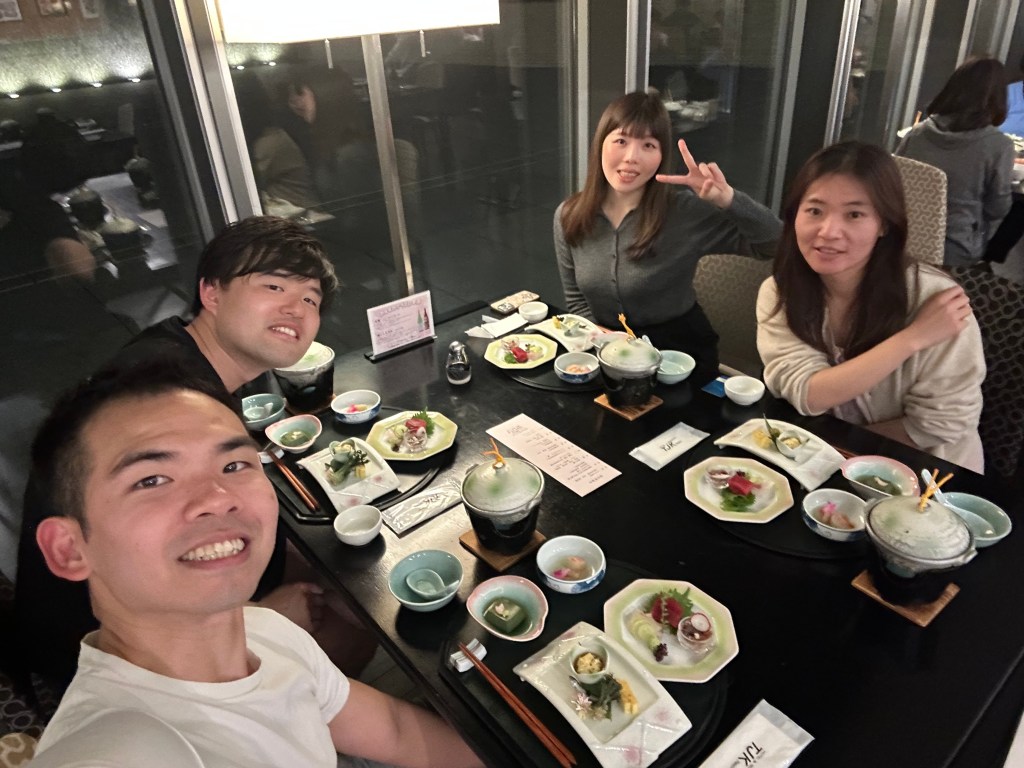
Which is why it was gratifying to be invited by a group of colleagues (and friends) to spend a weekend at the sanatorium owned and operated by TJK, the TJK Hakone Forest. The three of them, Hiro, Guilin and Maako joined the company at the same time late last year and dutifully perused the list of benefits that employees are entitled to. One of which is staying at the three sanatoriums owned by the association with the one in Hakone being the most luxurious of the three. All at the very-token price of 7,750 yen for room and 2 meals on a weekend at the heart of spring. With room referring to a 40 square-meter space with a floor-to-ceiling panoramic views of the eponymous Hakone forest that also comes with a kitchenette and a tub made from cypress bath. And meals referring to a full Japanese dinner banquet and a breakfast buffet with both Western and Japanese cuisine and locally-produced kamaboko (traditional Japanese fishcake).

Posing for dinner after being floored by the facilities in the resort

It’s such an unbelievable deal that a significant percentage of these 310,594 members frequently apply for it. Due to overwhelming demand, guests are chosen by ballot and we were fortunate enough to be chosen for our desired dates and accommodation type. In my case, I was even more fortunate to be invited to (or should I say free-ride) on my colleagues who went through the paperwork and a questionable booking system to secure this weekend getaway.

The availability (or lackthereof) of rooms in the resort even on weekdays

I had to constantly remind myself that this place is not a typical ryokan despite serving as one. The chasm in cover price and the level of amenities left a distant hum of cognitive dissonance in all of us who have been instilled with a mental map of price to expected offerings in Tokyo. It was a dissonance which we tried to both affirm and dispel by repeating at random intervals how unbelievable this whole set-up is. Even the prices of add-on drinks, lunch and amusement facilities were set at a level that further fuel this sense of unrealism; we were sure that karaoke rental rates there were even cheaper than those in the retro wooden two-storey establishments in the small towns of the countryside.

At a time where foreign tourists outnumber domestic ones (which we were made fully aware at Hakone Yumoto Station and on the ropeway ride), this resort stands out by being an almost-exclusive (with perhaps Guilin and myself being the only reason for the “almost”) Japanese enclave. This is not a surprise since eligibility for entry to this establishment is to be working and not touring in Tokyo. The other hurdle is the Japanese language itself. The advertisements and application for this resort are only in Japanese, with no incentive and effort for translations to other languages. This (in?)advertently repels foreign expats in Tokyo who technically can ballot for this. Once again and this time ironically so, the sheer lack of other foreigners in such a touristy environment entrenched my sense of disbelief.

Incentives shape architecture. In profit-making accommodations, rooms are usually compact and positioned adjacent to each other in cookie-cutter configurations to squeeze every last yen for every tsubo of real estate. In this non-profit sanatorium, rooms are generously spaced out to maximize the nature views and sense of openness of each. As if to encourage us to let go of the stress that we keep closed and contained within us on a day-to-day basis.

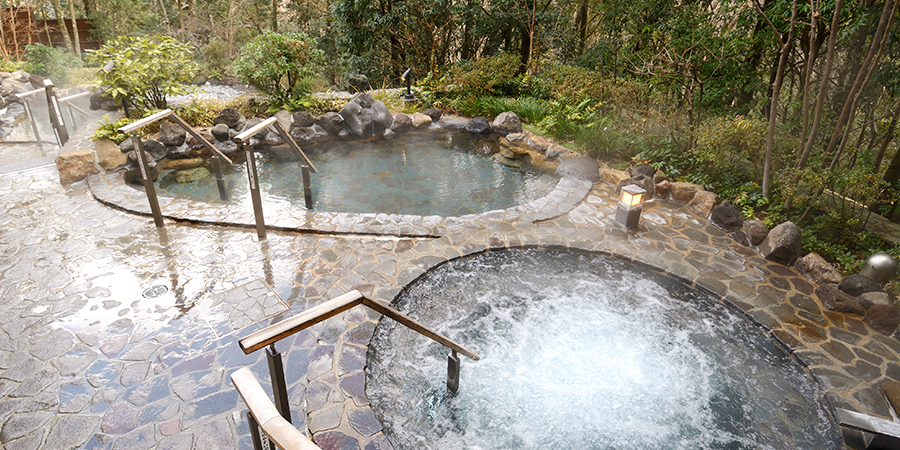
When it comes to de-stressing the Japanese way, one thinks of onsen. This is where the crown jewel of the resort truly shines. The changing room contains 50 (or thereabout) locker spaces, one sauna, one indoor pool and four outdoor pools cascading across three different levels and flanked by the forest. But whenever we were in the bathing area, there were 5 or so people (including us) and thanks to the different levels and distance, would not obtrude into one another’s personal space. To bathe both in the forest (森林浴) and springwater in such a dedicated expanse is the pinnacle of luxury and relaxation indeed.

Image from the official website; Hiro and I had the luxury of soaking in one pool each to ourselves

When planning for the trip, there were some concerns about how we would entertain ourselves at night after dinner. To that end, both Guilin and Maako brought along their Nintendo Switch, with enough controllers to test our growing friendship by playing Overcooked. In the end however, our friendship was tested over table tennis. Or to be more specific, Hiro and Guilin’s friendship as they bickered (very much in jest I hope) over their competition and cooperation when it comes to returning the ping pong ball from Maako and me.

Admittedly, what I gained more from the trip than the scrumptious meal and the extravagant room and bathing facilities was a newfound appreciation for active entertainment and amusement. And I am sure it was not just me. Hiro might have initiated the idea for playing ping pong when reminiscing about his days at Cambridge but in the end, it was all four of us who more than willlingly returned to the nondescript amusement room twice the next day.

I have never (and still don’t) fancy myself a sports-type. Yet I cannot deny the excitement which I felt when seeing my shots land and building a rapport through volley records with my friends.

We counted the record number of times we could successively keep the ball bouncing on the table more than who “won” or “lost”. We cheered one another with every skilful serve or masterful maneuvering. We lost track of time playing and many calories along the way too.

I did not get much sleep that night (more a personal quirk than a lament about the facilities). But the sojourn in the resort did rekindle a passion to try new things, make more mistakes and get better. This perhaps more than anything is what was needed from the stagnation of being in the same type of job and doing the same kind of work for more than five years. Here, more than any 慰労会 (dinners given in appreciation of one’s hard work) or utterance of お疲れ様です (a greeting which loosely translates to ‘thank you for your hard work’ used among colleagues), I feel the gratitude for my work and commitment since coming to Japan.

I believe all of us felt the same. The only question is when our next trip back to the sanatorium will be, hopefully out of want than out of need.

Juunenmae (Ten Years Ago)

Exactly ten years ago from today, just a day after arriving in Japan for the first time

It’s been more than half a year since my last entry, which is to say that this entry has been half a year delayed. Life (or if I were to be more honest, laziness) got in the way.

Today marks the start of a new year in Japan. The cherry blossoms are in full bloom here in Tokyo although that’s the only natural phenomenon in sync with the calendar this year. As I type this, it has been raining monsoon-like for 24 hours with temperatures hovering around 6 degree celsius in the day. Spring may have sprung upon us, but summer threatens to creep in even while winter refuses to let go.

Ten years ago, it was different. I would know because ten years ago from today marked my first ever trip to Japan. Back when I was touring and looking at the country with sakura-tinted glasses. Back when I would muster the courage to ask questions in Japanese to service staff memorized from textbooks and guide books. Then do a little jig to myself when I get a nod of understanding and a reply that I could not understand anyway.

Ten years ago, I checked into a hotel in Tsukiji upon touching down and thereafter let myself roam and explore without an atlas, thinking that I’d end up in Ginza only to find myself in Shiodome.

Ten years ago, I woke up at 3AM in the morning just so I could catch a glimpse of the first auction of the day at Tsukiji. And killing time at the waiting area by reading Letters from a Stoic.

Ten years ago, I was trying to submit a claims form for a CD transcription assignment (back when AI tools didn’t quite exist) by asking for a scanner before heading to Tokyo Station.

Ten years ago, I pulled my Delsey wheeled luggage bag across the cobblestone walkways in the Imperial Gardens, and worrying about destroying the wheels on the very first day. Back when I was unaware that lockers existed in train stations, let alone tried looking for them.

Ten years ago, I had a Yokohama-style omelette rice bento for my very first ekiben on the Shinkansen.

Ten years ago, I felt that waiting a 15-minute interval between trains bound for Miyajima-guchi from Hiroshima station was very long.

Ten years ago, I struck up a fleeting friendship with a solo American female traveler who had been living in Bangkok while waiting for the ferry to Miyajima.

Ten years ago, I got lost searching for my own accommodation after safely guiding my newfound friend to hers and had to ask a young Japanese couple for help.

Ten years ago, I chatted with a guesthouse owner who knew about Lee Kuan Yew’s recent passing and expressed his condolences.

Ten years ago, I got lost again, this time at the sight of the Itsukushima Shrine floating above the sea against the soft evening hues in the background.

Ten years ago, I went to a ramen restaurant for dinner with this newfound friend and was prodded by a fellow Caucasian customer to eat the noodles quickly before they get soft at the owner’s behest. The Caucasian lady’s fluency in Japanese became my own inspiration to understand the language and culture of places that I visit and live.

Ten years ago, I embarked on my inaugural 11-day solo travel in Japan.

Ten years ago, I was so infatuated with the trip that I wrote a blow-by-blow of the entire journey by hand after I returned (and which I later typed and saved on the PC). I would be giving my memory too much credit otherwise.

Today, I woke up at 8.45AM in my sharehouse of five and a half years in Tokyo after spending the whole of my Sunday binge-watching When Life Gives You Tangerines.

Today, I worked at home through the company-issued laptop, grateful that I do not have to be commuting to the office given the suboptimal weather.

Today, I am reading a book written in Japanese about the influx of rich and educated Chinese nationals into Japan. It’s called 潤日 for anyone who is interested.

Today, I no longer have a deadline to my time here and have chosen to call Tokyo a home.

Ten years ago, if I had known what I do now, the trip to Japan would not have been as dreamy and magical. Tourists are not subject to onerous income taxes and deductions and neither are they expected to give fluent work presentations in Japanese. What I do know is that if I had not gone on that solo trip as a very impressionable 21 year-old, I would not be here today, sufficiently charmed by my experiences as an explorer to presume that living here would be a way to extend that dream.

As a much-less impressionable 31 year-old, I know better now. That the grinding bureaucracy is more the stuff of nightmares for one. But I also know that I have grown use to the cleanliness and little civilities here. This is also the place where I have achieved many of the milestones that mark adulthood. This is where I feel at ease to be myself and be by myself.

The longer I stay, the more comfortable I get. Too comfortable perhaps. Throwing down the gauntlet and uprooting myself to live and work in another foreign country again though may be besides the point. It feels almost petulant to be repeating the challenge just for the sake of it. That being said, my current lackluster efforts to learn Korean and French would definitely benefit from this.

Beyond expanding my polyglot portfolio, I do have a keener interest in being better at what I do. Consulting as a profesison has its fair share of criticisms, but I still do believe that there is value in what we do in certain contexts. Even if it’s just borrowing the client’s watch to tell them the time. Because based on my experiences, it can be audacious to assume that the client can tell the time and understand its full implications. Plus there are times where many key stakeholders may have different methods and incentives for telling the time.

Ten years ago, I had no idea what I wanted to do. Only what I could not. And I ran away to Japan shortly after as a way to escape from turning down what I thought was the biggest dream and ambition of my life back then.

Now, I have a clearer idea of what I am doing. And what I can. And I am still in Japan to see this through.

White Horses

Taken from the top of Mt. Shirouma (White Horse)

Hiking / 爬山 / ハイキング – whenever someone asks me what kind of hobbies I have, that becomes the default reply. But since I twisted my ankle badly early early last year (and just general laziness really), I haven’t been doing much of it at all. To the point where claiming that as a hobby feels closer to fabrication than fact.

But that was something I wanted to change. Instead of just hoping that my injured ankle would fully rehabilitate on its own, I started going for regular chiropractor sessions. All with the goal of conquering the mountain of my screensaver dreams: Mt. Shirouma (白馬岳) in the Japanese Northern Alps.

That dream started when I was traipsing around the Internet while holed up in the IT service center in an industrial estate in the middle of Kanagawa prefecture in my first consulting engagement. The work was as dry and dreary as the premises were and to distract myself from the very real possibility that I might have screwed up my professional life at its very outset, I searched for mountains to climb. That was when I chanced upon this webpage. And in that moment, I knew that I would not be able to leave Japan without stepping foot on this majesty of a mare of a mountain.

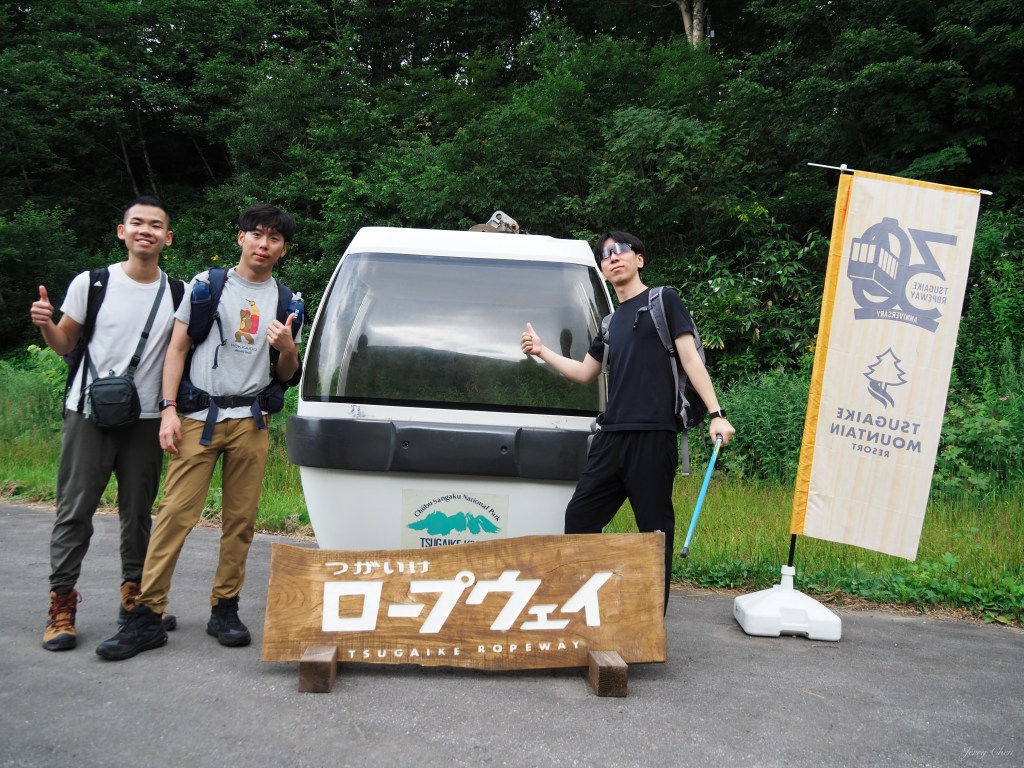
Fast forward five years and many consulting engagements later, that screensaver became a sight I got to behold with my own eyes. And with the best hiking buddies that I could ask for on this trip really: Jerry and Yuhao. If I had wanted to climb Mt. Shirouma alone, I would have done that much earlier on. But I wanted to share this experience with friends whom I know would enjoy this as much (along with a whole list of other demanding attributes on my end). And if it took years to find this combination, then years it would take.

The hike itself did not take as long: about two days with an overnight stay at the large mountain ‘hut’ (more of a lodging complex) a 20-minute climb from the summit. But it was definitely one that all of would remember for a long time to come.

Truly the calm before the (thunder)storm

Not least because we had to brave a thunderstorm to reach our destination! The weather forecast had not been great and I has been rather circumspect about the hike. Meanwhile, the rest of the group was more optimistic, with Jerry claiming that his ‘teru teru bozu‘ (テルテル坊主) – that refers to a traditional Japanese handmade doll for dispelling rain – abilities will ward off bad weather. Unfortunately, the mountain ranger whom we spoke to did not agree with Jerry’s sunny outlook and warned of an impending typhoon in the afternoon. It was already 9:30 AM then and

But all of us were ready to hike after spending the better part of the previous day making our way by Shinkansen and then rental car to Tsugaike Kogen, the base of the hike. There were a few clouds above us, but by and large the skies were clear…

…until they weren’t and a sudden torrent of rain left us scrambling to waterproof our clothes and gear along the granite slopes two hours into our ascent. We trudged on as the heavens continued pelting raindrops on us, occasionally letting up but never truly giving up.

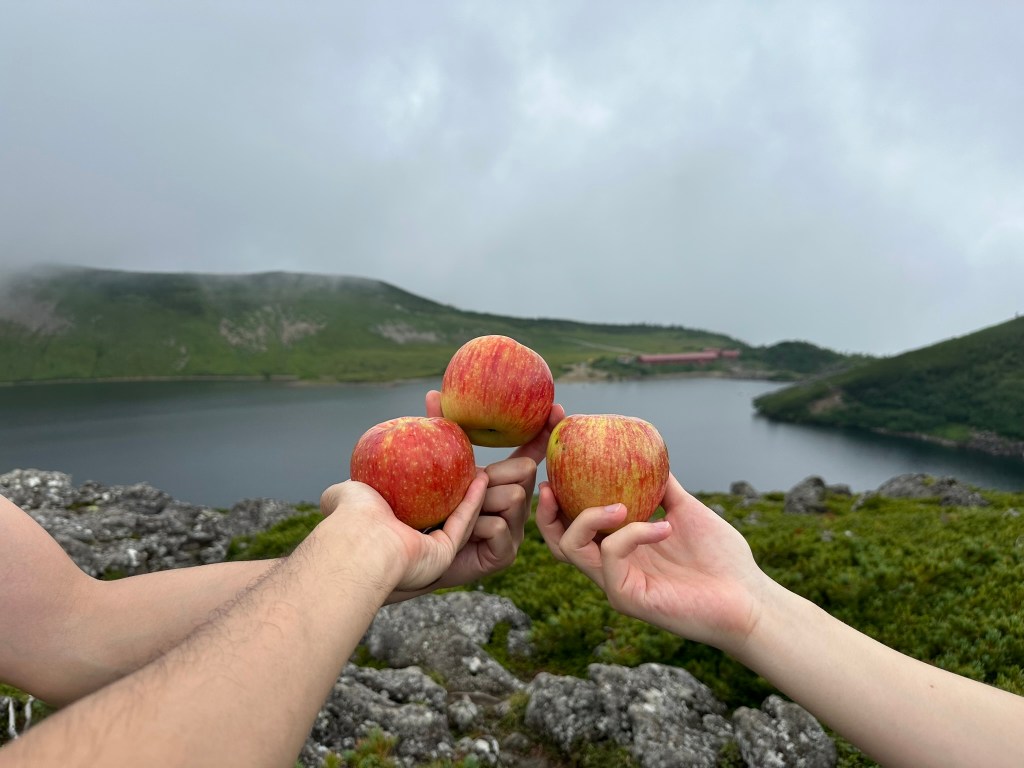
After an hour or so of intermittent rain, we began to see interstices of sunshine poking through the overcast sky. It seemed like a tentative truce among the heavens had begun. We found ourselves a rest spot in an outcropping overlooking the Hakuba Oike Lake and enjoyed the locally-produced apples bought at a pitstop at the local supermarket the previous day.

These apples taste a lot better 3 hours into a hike and 2,400m above sea level

At 1PM we found ourselves at the compact Hakuba Oike Hut which marked the midway mark of the hike to our destination. There was a small cafe of sorts selling food and drinks at prices as high as the altitude was. ¥800 for a bottle of Ayataka green tea that would have cost one-fifth the price in most vending machines in Tokyo. Though as most dine-in cafe patrons would attest to, the payment for the drink is more for the table and the seat than for the beverage in and of itself.

There, we consulted with the store manager, a severe-looking Japanese lady with an uncharacteristically sharp tongue. That sharpness was on display as we witnessed a conversation she had with a Japanese companion/interpreter of a foreign-looking hiker. Apparently, the soles of the foreigner’s hiking shoes had come apart and they were deliberating if their party should continue to Hakuba Sanso, seek shelter at the Hakuba Oike Hut or attempt a return to the trailhead at Tsugaike Nature Park. She did not hold back in lampooning his naive hope of reaching the summit of Mt. Shirouma with a sandwich of a shoe.

In search of similar hard-truth advice, we asked her if our party of three, all with shoes thankfully still intact, should take the risk of attempting to summit Mt. Shirouma that afternoon. With a cursory glance at our build and a question about how long it took us to arrive at her hut from the trailhead, she ventured cautiously that it shouldn’t be too much of a stretch for us, especially since the latter half of the route would be less technically demanding, though it would be a touch longer. She added as well that due to the adverse weather outlook that her hut was already over-capacity. It was not raining though the skies were still grey.

The weather may be unpredictable, but our commitment to finish what we started wasn’t. Especially if the alternative entailed squeezing like a can of sardines with a bunch of other unwitting, stranded hikers, some who might have nonfunctional shoes. And so we continued our hike come what may.

Not recommended.

And there came a thunderstorm.

The showers we encountered in the first half was a dress rehearsal. This thunderstorm was the opening play, replete with peals of thunder reminiscent of applause from an invisible audience.

*Clap* *Clap* *Clap* Well done on choosing to push ahead *Clap* *Clap *Clap*

We were easily the tallest objects as no trees were found at this altitude and very susceptible to being struck by lightning. Despair was close at hand, but so was a dogged pragmatism to keep going because of a shared cognizance of inertia and an urgency to arrive before it got too dark.

不怕慢,就怕站。(”Don’t be afraid to be slow; just be afraid of standing still”)

In front of me was Yuhao who was soaked to the skin and alternating between cursing at the weather and the store manager who suggested that we proceed with the hike. His jacket, pants and shoes were woefully inadequate to handle nature’s ire. But still, he pushed on. In a short intermission, I passed to him a spare polyester jacket which had been largely protected from the rain. That gave rise to Yuhao 2.0, a version which was undoubtedly more upbeat.

Very-well-equipped Jerry and Yuhao 2.0

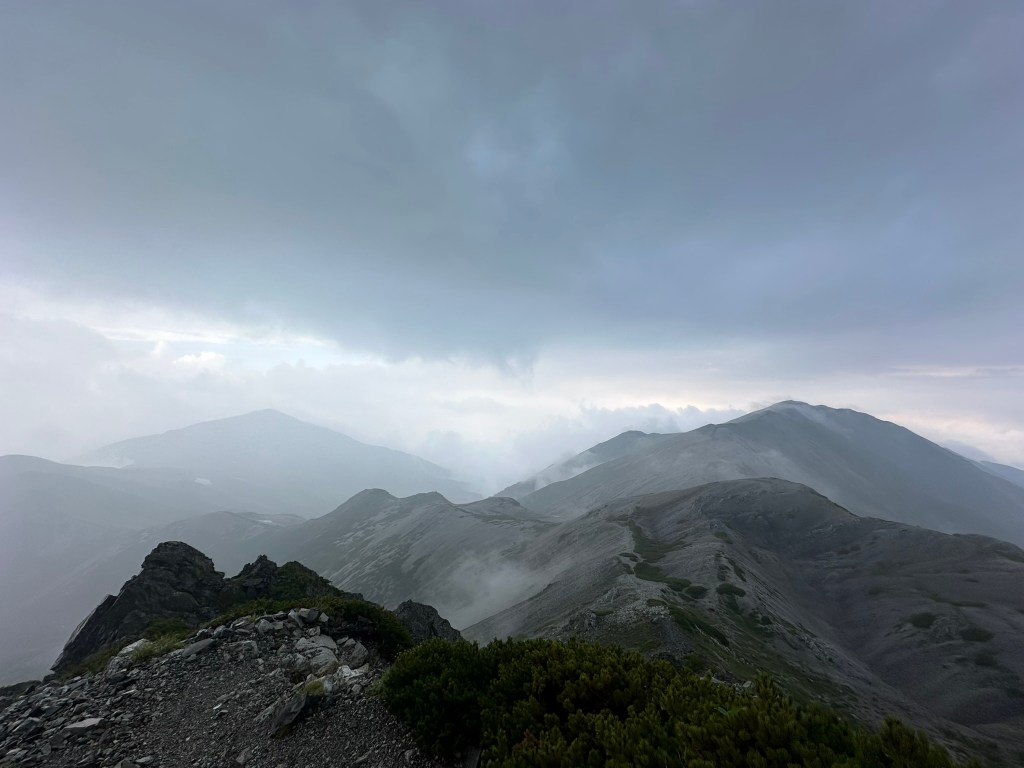
As we climbed higher, the thunderstorm started to subside into a drizzle. When we reached the mountain ridges, the path ahead sloped downwards and the cold started to set in. The surrounding mountains remained shrouded in clouds for the most part though there was sufficient visibility to behold the magnificence of the Japanese Northern Alps. And the great consolation prize of hiking in such inclement weather meant that we had the whole place to ourselves and there wasn’t another soul in sight for pretty much the entirety of the second half of the hike.

Nature gave us all a break

By time we arrived at the mountain hut, it was already 5.30PM. We were supposed to arrive at 3PM. The lack of mobile signal throughout the hike meant that I did not notice all the missed calls that came from the Hakuba Sanso staff attempting to ascertain our safety. After 8 hours of hiking, I had wanted to lounge by the space heater at the corner of the reception hall. But the notice from the staff about the closing of the dining hall at 5.40PM meant that we were soon chased to check in and eat dinner.

Not that we needed any prompting. We were ravenous, or at least I was, and there was nothing like a piping hot meal to recover from the arduous climb. We made it. It was only when I devoured the first clump of warm steamed rice that it truly sank on me that we had safely completed the ascent. I swallowed both the rice and relief in equal measure.

I would like to say that the descent was a much less dramatic affair. But it wasn’t. And in the best way possible because the views were absolutely breathtaking.

Is this what heaven looks like?

Now this is what we came for. Our feet were on solid granite ground but at 2,900m above sea level, we were otherwise surrounded by a sea of clouds. It’s moments like these when you can savour how wonderful it is to be alive, to be able-bodied, to have the means and the will to experience the best of what the world has to offer.

We weren’t alone this time and there was a steady trail of hikers who had departed at approximately the same time since we were all advised to return to trailhead by early afternoon to avoid another impending deluge. We needed no further prompting this time to set off early.

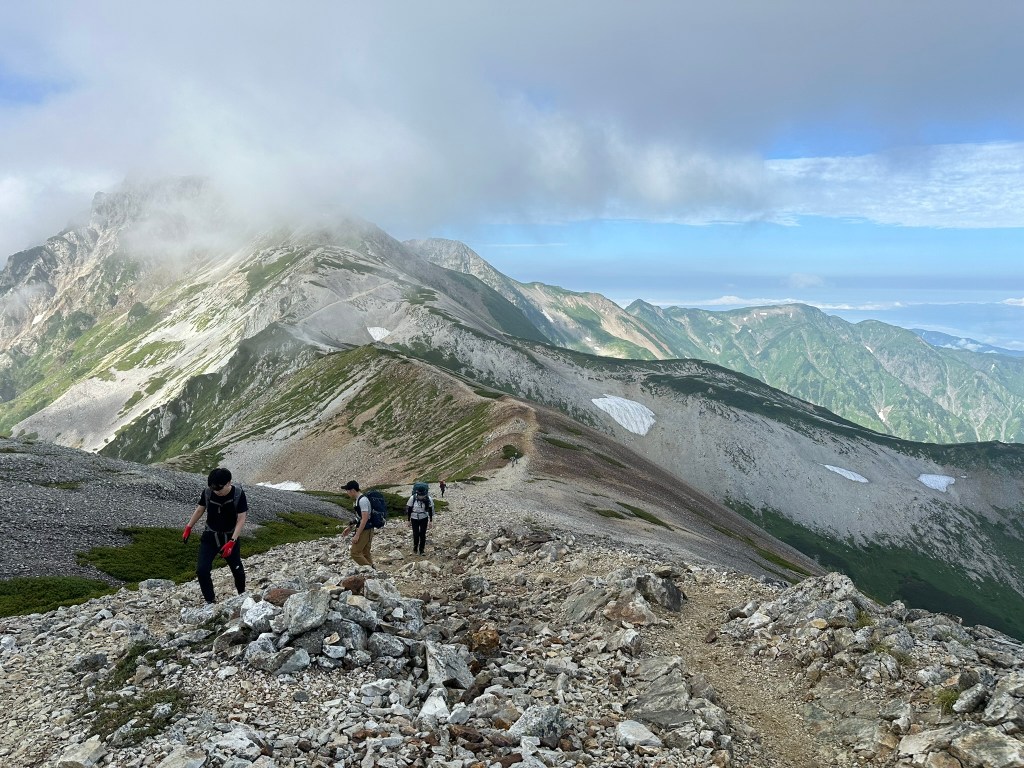
Even though we were returning by the exact same route, it felt like a new route altogether and there were countless times where we had to verify within ourselves where the ascent equivalent of every turn and meander was, especially if it was followed by a particularly challenging stretch. How did we cover all of that in the rain?

It did not look so long on the way up

As we traversed across the undulating mountain ridges and feasted on the surrounding panorama, I could not help but ponder about the name of the mountain: White Horse. A cursory search online (Japanese site) revealed that it arose from how a section of the mountain relief resembled that of a horse. But why white then? Because of the snow that brings the mountain relief into sharp relief?

The reason is alot more mundane: the horse itself was imagined to be those that were used in tilling the soil prior to planting rice in the paddies surrounding the moutains. And it so happened that this activity shares a homonym with the Japanese character for ‘white’.

I am not an equestrian, and have no plans to be one. But half a lifetime ago, the term ‘white horses’ did play a formative role in my life. I was in the school choir back then and we were preparing for the biennial choral competition, the Singapore Youth Festival (SYF). The set piece for the competition then was “White Horses” by Australian composer Stephen Leek.

I’m first guy from the left on the third row

Which is why the term ‘white horses’ for me has also come to mean incredible shared effort, to be followed by incredible shared results. For the SYF, the training practices were intense and gruelling but it resulted in us clinching the Gold with Honours award as a team. That sheer elation that the choir felt, that I felt, when the results were announced remains a core memory to this day.

Gallop and gallop 15 years forward, and we came, we saw and we conquered. And I know that now I have another core memory. Thanks for the memories.

Snapshots from Okinawa

Getting out of the airport, one is immediately struck by the humidity of the place. Okinawa in May feels like Singapore with the thermostat set a few degree celcius cooler; my friends had travelled 3,750 km only to find themselves back to where they departed while I found myself home away from home. But perhaps the more appropriate comparison would be Malaysia. Instead of towering skyscrapers, concrete structures of a few storeys high, ranging from quaint shophouses to private residences, scatter across the lush and verdant tropical vegetation. Even the heart of Naha felt like a throwback to the 1990s, save for a handful of newly constructed luxury hotels.

Perhaps a three-way fusion of mainland Japan, Taiwan and Malaysia would be the best way to describe it. Yes, Japanese is the official language there but in Makishi Public Market, it is the signs in Chinese promoting the preparation of live seafood on display that stand out. The streets are grimier with stalks of weed and the occasional wildflowers poking out from crevices on the pavements but general litter is conspicuously absent. The people are a tad more coarse and direct, but also warmer in their interactions. We talked about how one could transplant a random shophouse from Taiwan or Malaysia there and no one would be able to tell the difference, since the Japanese kanji and Chinese hanzi are just about indistinguishable without the hiragana or katakana flourish.

The highlight of the trip though was the food. I have a soft spot for Okinawan food seeing how among all the different types of Japanese cuisine, it is amongst the most homely. Kyoto-style kaiseki is exquisite no doubt but it is not something that one can afford to indulge in regularly and its fanciness (and coldness) invokes an unwitting hesitation to actually eat it. But it’s a different case for Okinawan food where signature dishes are typically stir-fried or stewed with literal and figurative down-to-earth ingredients almost guaranteed to laden an empty stomach. And they are good for your health too. No wonder that Okinawa is also one of the world’s Blue Zones, areas where the population has a life expectancy much higher than the global average.

Food does not lend well to my mediocre photography skills and inability to resist the scrumptious dishes laid in front me (the camera never really got to “eat first”). So instead, here are 6 pictures that completely fall short of capturing our vacation on this idyllic island which once bore witness to the “typhoon of steel”.

(Note: The nicer photographs are attributable to my friends)

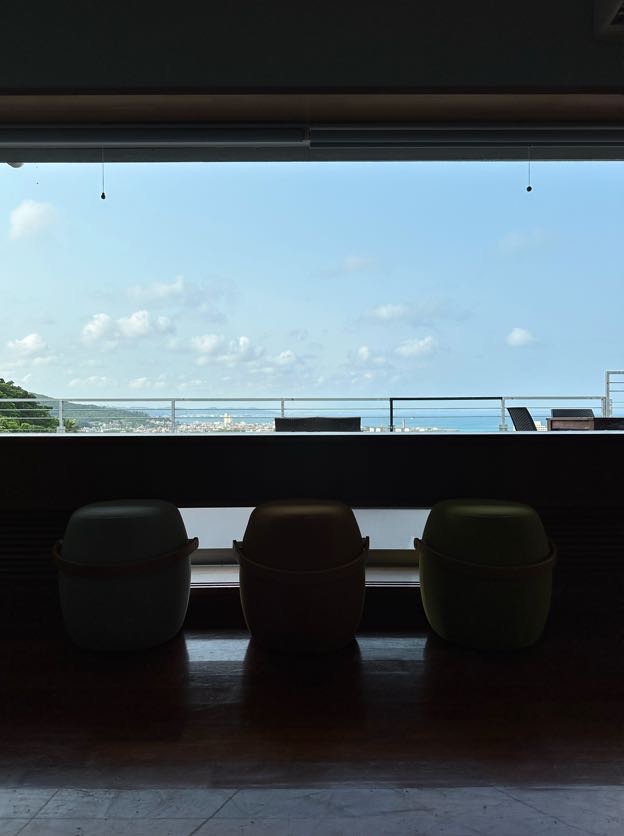
Nestled in Nanjo, a 30-minute drive from Naha, this Airbnb featured a jaw-dropping panorama of the urban coastline set against the cerulean Philippine Sea. It was home to our party of 3 for the entire trip, and a departure from the thrift that marked our Iceland trip seven years ago as students.

Instead of looking at the surface of the sea, we got to see the inside of it in the Churaumi (literally “beautiful sea”) Aquarium. It no longer holds the world record for largest aquarium in the world but it certainly holds a special place in our heart.

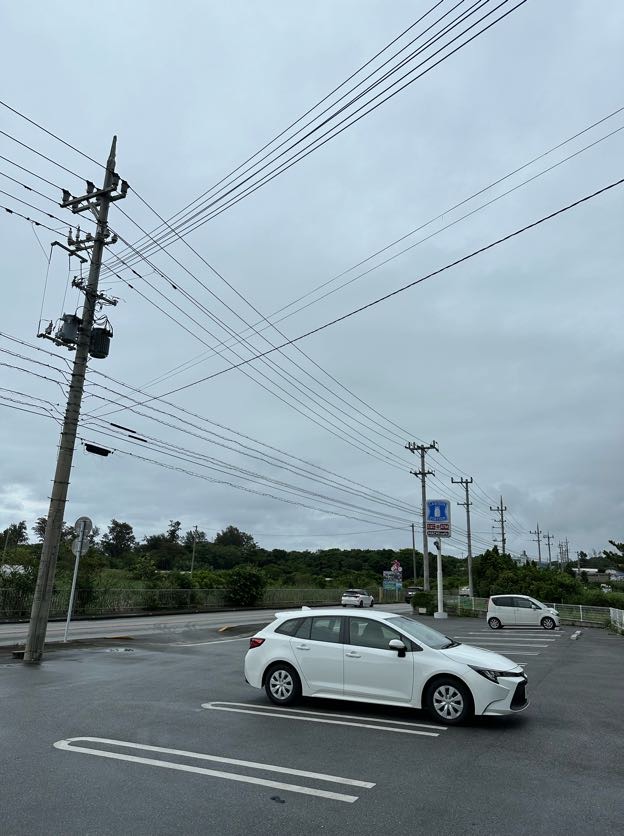
With the state of public transport infrastructure a far cry from that in the mainland metropolises, rental car was the way to go. And with it, we got to relish one of the idiosyncratic joys of roadtripping in Japan: a pit stop at the local konbini for coffee and snacks.

Limestone caves are not unique to Okinawa but the Gyokusendo is one of the largest cave systems in Japan; large enough to accommodate the cohorts of junior high school students who thronged through the narrow passageways.

The colored spotlights and shaved stalactite walkways were a reminder that this is as kitschy of a tourist attraction as they come. But that’s exactly what we were: tourists.

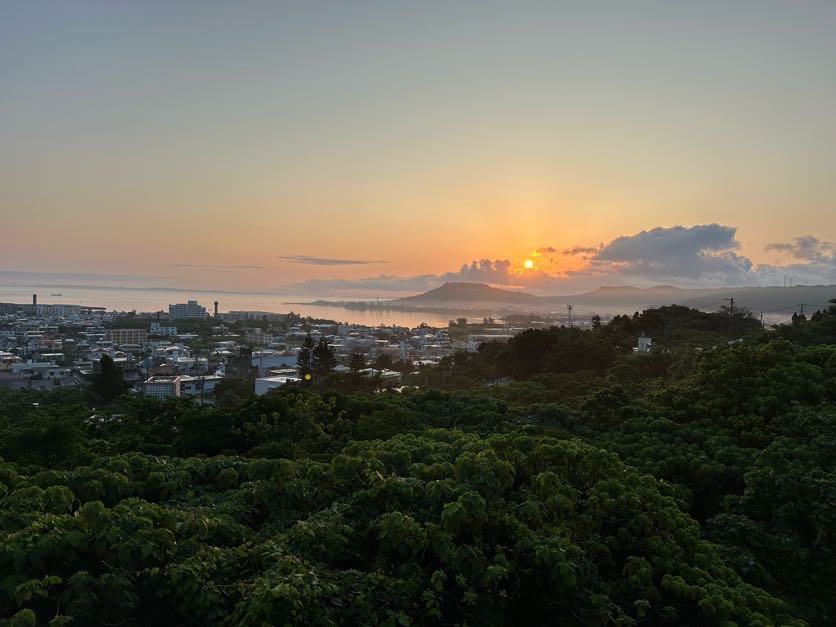
This was the promise on the Airbnb site that convinced us to book this place notwithstanding the musty odour and dated furnishings. A really great start to the day.

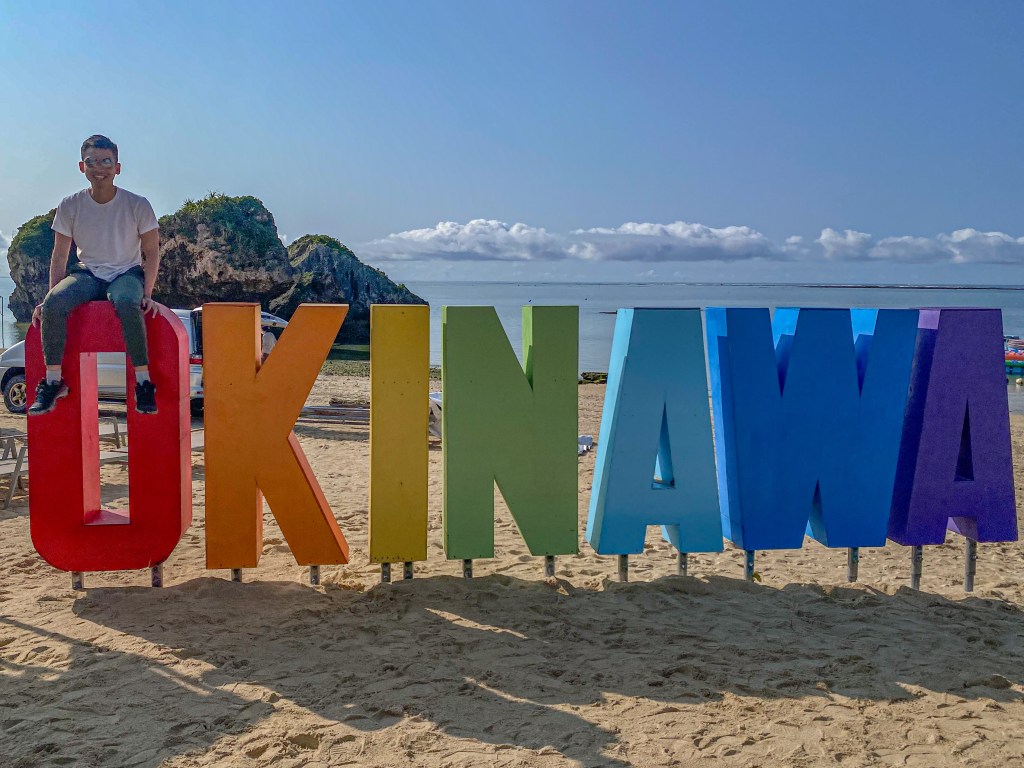
We were wondering about the best angles to take a photo with this iconic structure along Mibaru Beach when I noticed scratch marks on top of the “O”.

One “muscle-up” later.

The Culture Map

There are two young fish swimming along and they happen to meet an older fish swimming the other way, who nods at them and says, “Morning boys. How’s the water?” And the two young fish swim on for a bit, and then eventually one of them looks over at the other and goes, ‘What the hell is water?

The quote from David Foster Wallace above is as short an allegory on culture as they come. We don’t notice it until we are thrust in a different environment or meet creatures who interact with it in different ways. Say in part two of the quote, these young fish eventually meet a turtle swimming the other way. The turtle which splits its time between land and sea may be able to illustrate more clearly that it isn’t just water that can be different: that even that their medium of existence isn’t the only media that sustains life.

But that’s provided that the turtle can speak a common language and convey such a point with the young fish in the first place without any misunderstanding. The Culture Map, is the name of a book from INSEAD professor Erin Meyer, where she illustrates how miscommunication can occur so easily and unintentionally across cultures in the corporate context. In the book, she provides a framework for plotting how cultures differ along 8 different dimensions, replete with the mapping of the larger and globally prominent countries’ culture in each dimension.

I chanced upon the book at a Kinokuniya outlet in Shinjuku last month, perched on the bestseller shelf in the English section. Strange enough, for a presumable bestseller there weren’t any quotes from major literary figures or awards or time spent on bestseller lists. But the title was captivating and sure enough, I found myself reading the book cover-to-cover. Twice.

It’s a masterclass in cross-cultural communication and crystallizes what many a left-brained colleague would dismiss as ether. But it’s ether that translates to very tangible consequences when deals fall apart because of a mutual lack of trust and understanding. The book itself is also a consultant’s dream, with a strong foundation of frameworks while being laden with many thought-provoking anecdotes of faux pas and lessons learned from Erin and her seminar participants. For those who are looking for concrete tips, the book gives them in spades from how a presentation should be structured to content that should be contained in emails.

It’s a breezy read which would certainly help those who cannot read the air. For a summary of the key takeaways of this book, I recommend reading this post from LinkedIn.

As the book presents as a disclaimer, the position of a culture on the map is just one aspect that should be considered in interpreting and crafting communications. After all, the plotting of a single point on the spectrum for each dimension is a simplification, and was derived as the mean of a population of responses from each surveyed culture. Within each culture, there is a range which is considered appropriate. This takes into the account the other aspect: differences in people’s personalities. According to the book, taking these two into account will allow for effective communication.

To that, I would like to add a third layer: discounting for foreigners. Which is to say that natives tend to be more tolerant of cultural foibles from foreigners in day-to-day interactions. I believe it isn’t something which is mentioned in the book because it would arguably dilute its value: is there a need to really absorb the lessons and tips if the get-out-of-jail-free card can be easily played?

But it is a phenomenon which has played out in my time here in Japan at least. Or it could also be unique to Japan, or my position as a Singaporean in Japan. Or that there really isn’t any time to be doing nemawashi and getting everyone’s consensus before proceeding in consulting when what matters a lot more is getting quality output to the client by pressing deadlines.

Qualifiers aside, what this means is that I am constantly being “forgiven” for not conforming to the same social expectations, including those in communications. Like turning down requests directly instead of implying that “this would be difficult…”. And being able to get more time to think by asking my counterpart to repeat the question innocuously . And also why I have colleagues who will beckon me to interface with difficult clients because I am held to a different standard of delicacy, or lackthereof. The very same refusal or prevarication would have been interpreted as an offense from my Japanese or highly-naturalized co-workers.

Amongs the foreign expat community here, this is called playing the gaijin card. The downside of doing so all the time is that one inadvertently gets excluded from ever being part of the “in-group”. But I have never ever thought of myself as Japanese, or even wanted to be Japanese. What I have wanted is to be able to speak the language and understand a way of life that is different from my own. All while respecting this place and its people while adhering to my beliefs.

In short, to be the older fish that can tell how Japanese waters differ from Singaporean ones. To know that there are different waters out there in the world and to be able to swim just fine in many of them.