

Hiking / 爬山 / ハイキング – whenever someone asks me what kind of hobbies I have, that becomes the default reply. But since I twisted my ankle badly early early last year (and just general laziness really), I haven’t been doing much of it at all. To the point where claiming that as a hobby feels closer to fabrication than fact.
But that was something I wanted to change. Instead of just hoping that my injured ankle would fully rehabilitate on its own, I started going for regular chiropractor sessions. All with the goal of conquering the mountain of my screensaver dreams: Mt. Shirouma (白馬岳) in the Japanese Northern Alps.
That dream started when I was traipsing around the Internet while holed up in the IT service center in an industrial estate in the middle of Kanagawa prefecture in my first consulting engagement. The work was as dry and dreary as the premises were and to distract myself from the very real possibility that I might have screwed up my professional life at its very outset, I searched for mountains to climb. That was when I chanced upon this webpage. And in that moment, I knew that I would not be able to leave Japan without stepping foot on this majesty of a mare of a mountain.
Fast forward five years and many consulting engagements later, that screensaver became a sight I got to behold with my own eyes. And with the best hiking buddies that I could ask for on this trip really: Jerry and Yuhao. If I had wanted to climb Mt. Shirouma alone, I would have done that much earlier on. But I wanted to share this experience with friends whom I know would enjoy this as much (along with a whole list of other demanding attributes on my end). And if it took years to find this combination, then years it would take.
The hike itself did not take as long: about two days with an overnight stay at the large mountain ‘hut’ (more of a lodging complex) a 20-minute climb from the summit. But it was definitely one that all of would remember for a long time to come.
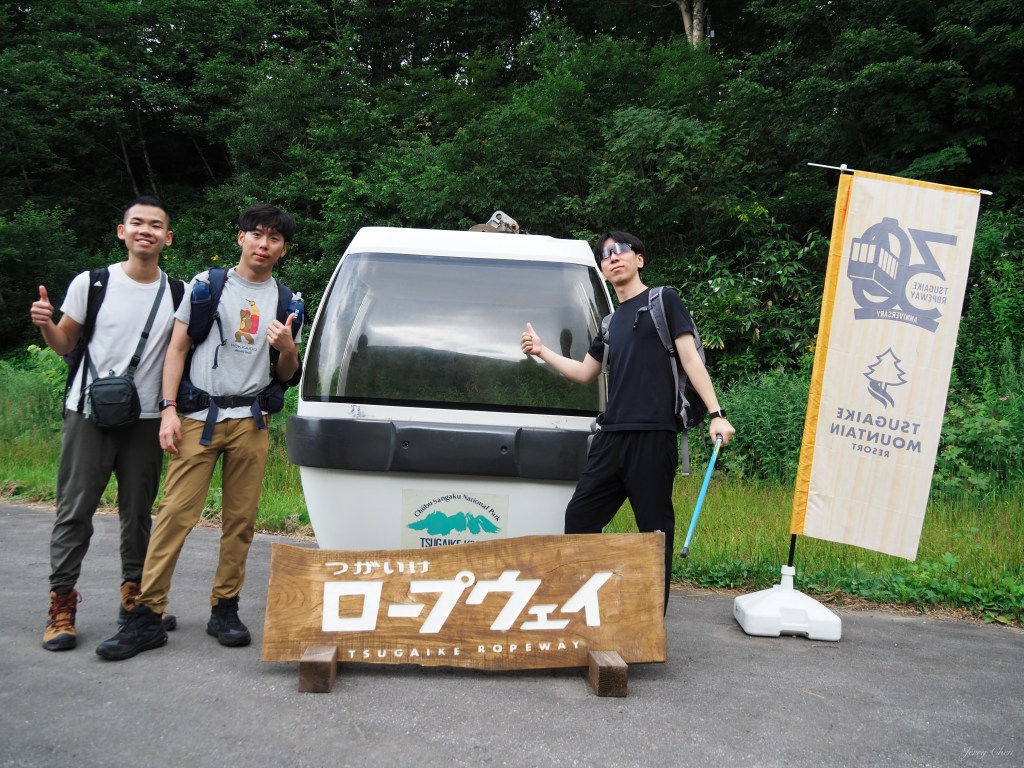
Not least because we had to brave a thunderstorm to reach our destination! The weather forecast had not been great and I has been rather circumspect about the hike. Meanwhile, the rest of the group was more optimistic, with Jerry claiming that his ‘teru teru bozu‘ (テルテル坊主) – that refers to a traditional Japanese handmade doll for dispelling rain – abilities will ward off bad weather. Unfortunately, the mountain ranger whom we spoke to did not agree with Jerry’s sunny outlook and warned of an impending typhoon in the afternoon. It was already 9:30 AM then and
But all of us were ready to hike after spending the better part of the previous day making our way by Shinkansen and then rental car to Tsugaike Kogen, the base of the hike. There were a few clouds above us, but by and large the skies were clear…
…until they weren’t and a sudden torrent of rain left us scrambling to waterproof our clothes and gear along the granite slopes two hours into our ascent. We trudged on as the heavens continued pelting raindrops on us, occasionally letting up but never truly giving up.
After an hour or so of intermittent rain, we began to see interstices of sunshine poking through the overcast sky. It seemed like a tentative truce among the heavens had begun. We found ourselves a rest spot in an outcropping overlooking the Hakuba Oike Lake and enjoyed the locally-produced apples bought at a pitstop at the local supermarket the previous day.
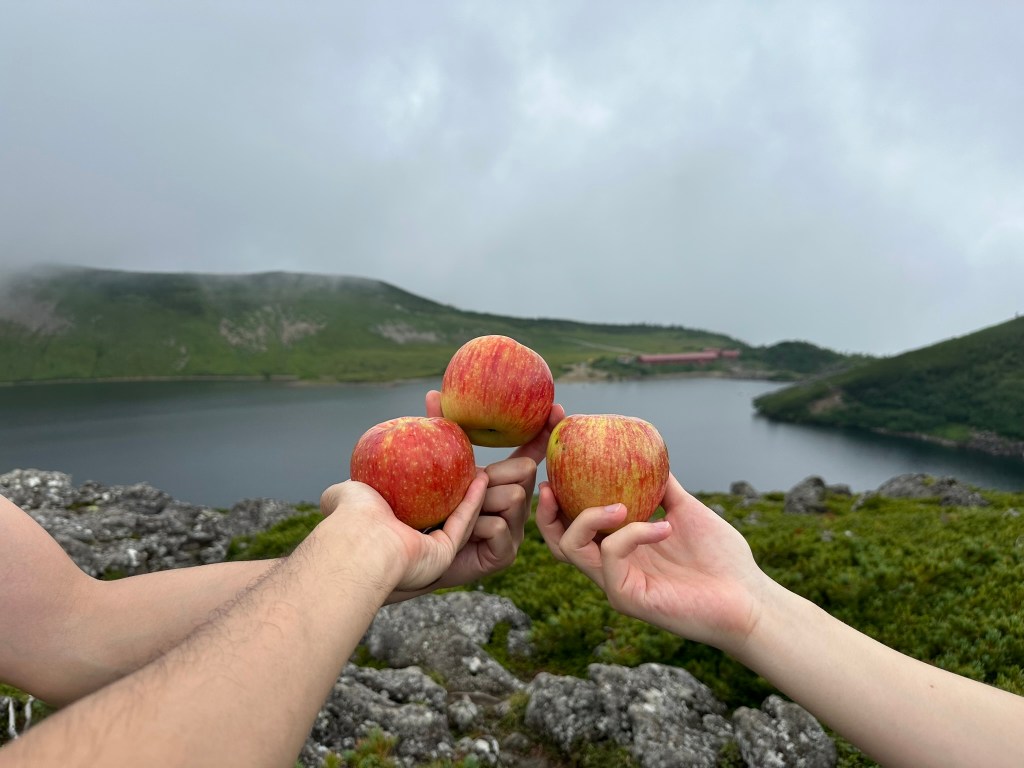
At 1PM we found ourselves at the compact Hakuba Oike Hut which marked the midway mark of the hike to our destination. There was a small cafe of sorts selling food and drinks at prices as high as the altitude was. ¥800 for a bottle of Ayataka green tea that would have cost one-fifth the price in most vending machines in Tokyo. Though as most dine-in cafe patrons would attest to, the payment for the drink is more for the table and the seat than for the beverage in and of itself.
There, we consulted with the store manager, a severe-looking Japanese lady with an uncharacteristically sharp tongue. That sharpness was on display as we witnessed a conversation she had with a Japanese companion/interpreter of a foreign-looking hiker. Apparently, the soles of the foreigner’s hiking shoes had come apart and they were deliberating if their party should continue to Hakuba Sanso, seek shelter at the Hakuba Oike Hut or attempt a return to the trailhead at Tsugaike Nature Park. She did not hold back in lampooning his naive hope of reaching the summit of Mt. Shirouma with a sandwich of a shoe.
In search of similar hard-truth advice, we asked her if our party of three, all with shoes thankfully still intact, should take the risk of attempting to summit Mt. Shirouma that afternoon. With a cursory glance at our build and a question about how long it took us to arrive at her hut from the trailhead, she ventured cautiously that it shouldn’t be too much of a stretch for us, especially since the latter half of the route would be less technically demanding, though it would be a touch longer. She added as well that due to the adverse weather outlook that her hut was already over-capacity. It was not raining though the skies were still grey.
The weather may be unpredictable, but our commitment to finish what we started wasn’t. Especially if the alternative entailed squeezing like a can of sardines with a bunch of other unwitting, stranded hikers, some who might have nonfunctional shoes. And so we continued our hike come what may.
And there came a thunderstorm.
The showers we encountered in the first half was a dress rehearsal. This thunderstorm was the opening play, replete with peals of thunder reminiscent of applause from an invisible audience.
*Clap* *Clap* *Clap* Well done on choosing to push ahead *Clap* *Clap *Clap*
We were easily the tallest objects as no trees were found at this altitude and very susceptible to being struck by lightning. Despair was close at hand, but so was a dogged pragmatism to keep going because of a shared cognizance of inertia and an urgency to arrive before it got too dark.
不怕慢,就怕站。(”Don’t be afraid to be slow; just be afraid of standing still”)
In front of me was Yuhao who was soaked to the skin and alternating between cursing at the weather and the store manager who suggested that we proceed with the hike. His jacket, pants and shoes were woefully inadequate to handle nature’s ire. But still, he pushed on. In a short intermission, I passed to him a spare polyester jacket which had been largely protected from the rain. That gave rise to Yuhao 2.0, a version which was undoubtedly more upbeat.

As we climbed higher, the thunderstorm started to subside into a drizzle. When we reached the mountain ridges, the path ahead sloped downwards and the cold started to set in. The surrounding mountains remained shrouded in clouds for the most part though there was sufficient visibility to behold the magnificence of the Japanese Northern Alps. And the great consolation prize of hiking in such inclement weather meant that we had the whole place to ourselves and there wasn’t another soul in sight for pretty much the entirety of the second half of the hike.
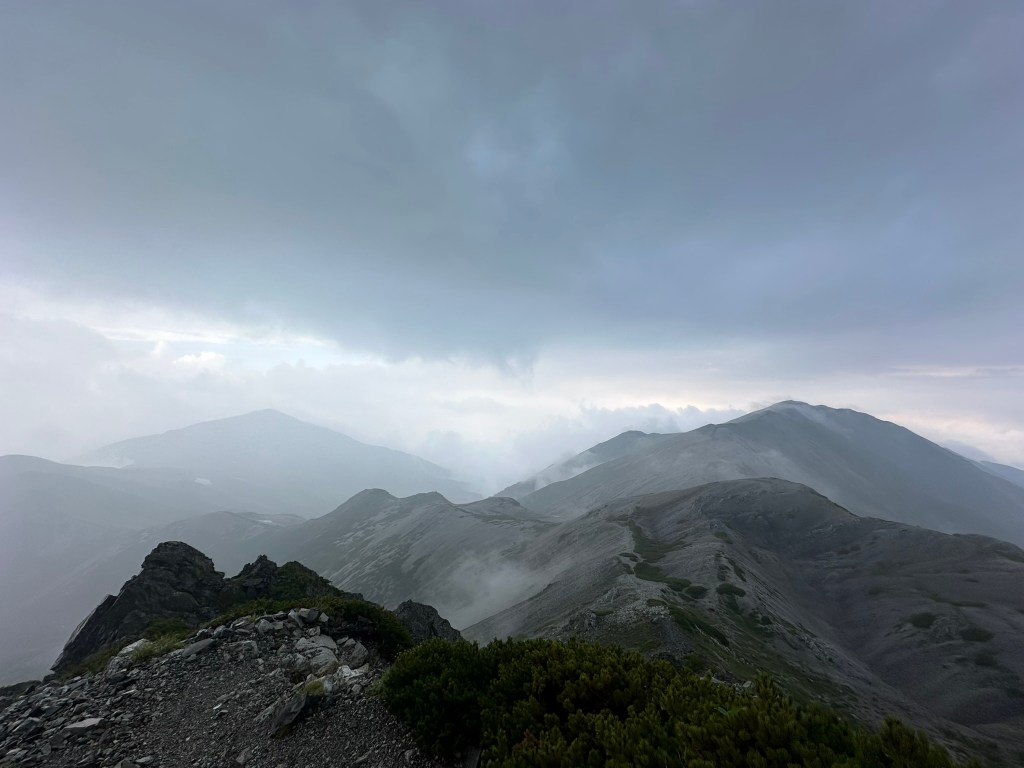
By time we arrived at the mountain hut, it was already 5.30PM. We were supposed to arrive at 3PM. The lack of mobile signal throughout the hike meant that I did not notice all the missed calls that came from the Hakuba Sanso staff attempting to ascertain our safety. After 8 hours of hiking, I had wanted to lounge by the space heater at the corner of the reception hall. But the notice from the staff about the closing of the dining hall at 5.40PM meant that we were soon chased to check in and eat dinner.
Not that we needed any prompting. We were ravenous, or at least I was, and there was nothing like a piping hot meal to recover from the arduous climb. We made it. It was only when I devoured the first clump of warm steamed rice that it truly sank on me that we had safely completed the ascent. I swallowed both the rice and relief in equal measure.
I would like to say that the descent was a much less dramatic affair. But it wasn’t. And in the best way possible because the views were absolutely breathtaking.
Now this is what we came for. Our feet were on solid granite ground but at 2,900m above sea level, we were otherwise surrounded by a sea of clouds. It’s moments like these when you can savour how wonderful it is to be alive, to be able-bodied, to have the means and the will to experience the best of what the world has to offer.
We weren’t alone this time and there was a steady trail of hikers who had departed at approximately the same time since we were all advised to return to trailhead by early afternoon to avoid another impending deluge. We needed no further prompting this time to set off early.
Even though we were returning by the exact same route, it felt like a new route altogether and there were countless times where we had to verify within ourselves where the ascent equivalent of every turn and meander was, especially if it was followed by a particularly challenging stretch. How did we cover all of that in the rain?
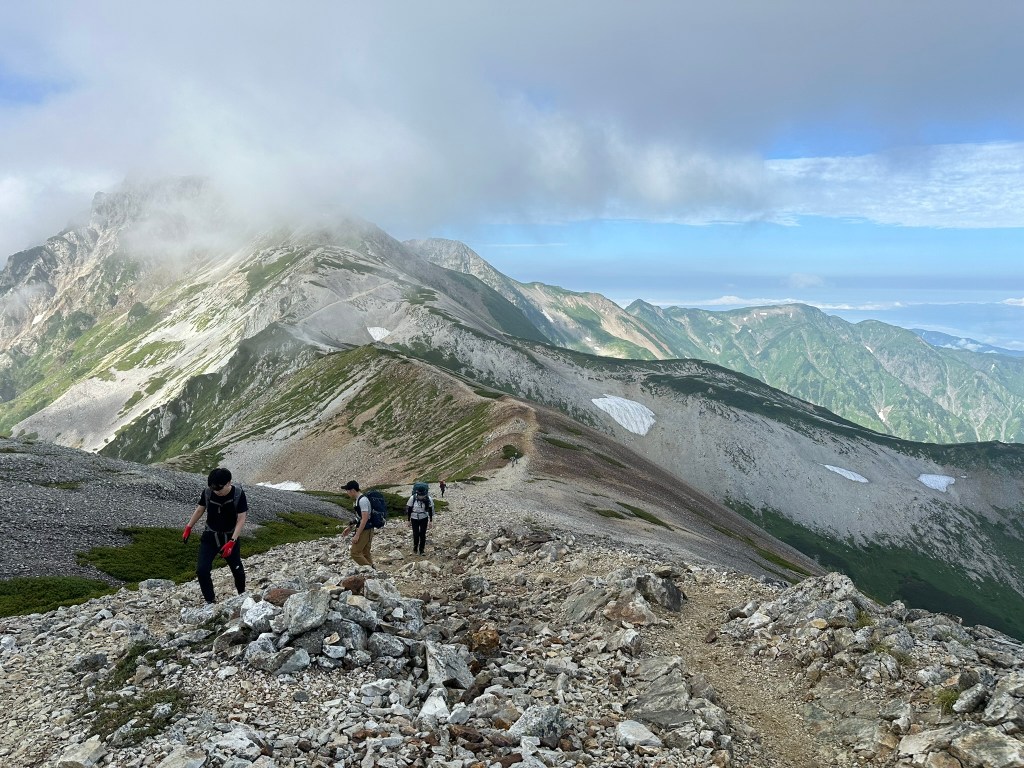
As we traversed across the undulating mountain ridges and feasted on the surrounding panorama, I could not help but ponder about the name of the mountain: White Horse. A cursory search online (Japanese site) revealed that it arose from how a section of the mountain relief resembled that of a horse. But why white then? Because of the snow that brings the mountain relief into sharp relief?
The reason is alot more mundane: the horse itself was imagined to be those that were used in tilling the soil prior to planting rice in the paddies surrounding the moutains. And it so happened that this activity shares a homonym with the Japanese character for ‘white’.
I am not an equestrian, and have no plans to be one. But half a lifetime ago, the term ‘white horses’ did play a formative role in my life. I was in the school choir back then and we were preparing for the biennial choral competition, the Singapore Youth Festival (SYF). The set piece for the competition then was “White Horses” by Australian composer Stephen Leek.
Which is why the term ‘white horses’ for me has also come to mean incredible shared effort, to be followed by incredible shared results. For the SYF, the training practices were intense and gruelling but it resulted in us clinching the Gold with Honours award as a team. That sheer elation that the choir felt, that I felt, when the results were announced remains a core memory to this day.
Gallop and gallop 15 years forward, and we came, we saw and we conquered. And I know that now I have another core memory. Thanks for the memories.
 Jin Pang