
For the uninitiated, that phrase above is a transliteration of 「日本語が上手ですね」which means “Your Japanese is really good”. Said (too) often by native Japanese folks to foreigners who are noticeably trying very hard to get the right words out in the right order. Normally in a conversation about the weather and other small pleasantries.
It’s intended as a compliment but may inadvertently come across as patronizing. This feeling is not foreign to a Singaporean of Chinese ethnicity who has travelled abroad and been told on no few occasions that “Your English is very good [for a Singaporean]”. I mean, English is the main language we use in the little red dot, though not everyone can slip in and out of the Singlish accent and mindset easily. It is only when someone says that my “Chinese is very good” that I truly blush a little.
But I digress. For this is a story of how I went from flubbing a burger order at McDonald’s to chiming in at a high-stakes client presentation in four years. And how your nihongo [Japanese] can be really jozu [good], explicit external validation not necessary.
It was September 2019 and I have just touched down at Narita Airport to go to seek my great perhaps. Exactly a year earlier, I was given an offer by my previous firm to return as a fresh graduate analyst, only now that speaking business Japanese “is expected”. For someone whose command of the language amounted to whatever was contained in the Genki I textbook, it was a tall order to say the least.
But if they believed in me enough to offer, surely I would be courageous enough to accept it. Plus I was curious: what would it be like to be a tabula rasa once more, as fresh graduates in Japan are expected to be anyway? In Singapore, I had hewed very closely to the archetypical aspiring Singaporean corporate professional path. This may sound audacious but I could see, even know how my life would turn out if I didn’t rock the boat.
So I rocked the boat.
It’s not as if I didn’t come prepared though. In that final year in university, I spent more time poring over Japanese textbooks and assessment books than on the tutorials that were supposed to help me graduate. All that cramming for the Ten Year Series from my primary school to junior college days did not go to waste. Within a year, I was able to clinch a passing grade for the N2 (second-highest level) for the Japanese Language Proficiency Test (JLPT).
In short, I should have been able to comprehend orally presented materials such as coherent conversations and news reports, spoken at nearly natural speed in everyday situations as well as in a variety of settings, and is able to follow their ideas and comprehend their contents [sic].
So with my (un)warranted confidence, I stepped into a McDonald’s to order my go-to, a fillet-o-fish burger a la carte. It is as simple as most orders go. What could go wrong?
「店内で食べますか?それとも持ち帰りますか?」(Dine here or to go?)
I was stumped. Apparently, my faculties for listening comprehension were only activated when I am seated with a test booklet in front of me and surrounded by other acolytes in similar postures. In the austere and quiet sanctuary of an examination room no less, of which a McDonald’s in Shibuya certainly was not.
After a few more weak-willed requests for the cashier to repeat, and even weaker-willed attempts at understanding, I retreated to clarifying in English what was being asked.
Surrounded by the growing impatience of both the cashier and snaking queue behind, my choice was clear.
So that nobody here has to duck out of McDonald’s prematurely again out of linguistic shame, here are three lessons that I learned in this journey.
1. Master the basics (which really aren’t that basic)
It sounds so simple but it is a lot harder, and requires much more discipline to accomplish in practice. In my valiant attempt to be at the “business-level” in the language, I pummelled through successive levels of the JLPT. Instead of starting from N5, the most basic JLPT level, I challenged myself to complete the N3 (Intermediate) in a few months with nary a foundation to stand on. To compensate for the lack of years of studying in a language school that one would normally need for this level, I shortcuited the process by reviewing my grammar notes repeatedly.
For me, the crux lay in the grammar because without which, I could not tackle the vocabulary and reading comprehension sections too. Without good grasp in grammar, one cannot expect to understand the relationship between terms. I could get by without mastering all the vocabulary as some of the kanji terms were the same as those in Chinese. Listening comprehension was pretty much a toss of the dice since there are only three options to choose from for each question. And one only needed 19/60 for each section to pass (subject to a minimum cumulative score). Thereafter, bulldoze through practice papers after practice papers to increase my familiarity with the test structure. The content of the questions may change, but not their presentation will not.
It was with this calculation that I sought to “game” the test, not just for the N3 but also for the N2, which I took six months after. But Japanese is not just a test subject; it’s also the 8th most spoken language in the world. And it has the complexity of one where its native speakers are amonst the most literate globally. It was indeed misguided of me to think that a year of hard studying and not much else would be enough to be at the business level; it may not even be enough for ordering at McDonald’s.
What did help me approach that level in my years here was going back to the basics. Even with the “N2 Pass” under my belt, it was the Genki I textbook that remained my constant companion. Before tackling the esoteric あるまじき, it is crucial to understand が、を、に、で and は and the essence of what they mean. The former may be fancy but its use is highly regulated and specific. On the other hand, the common Japanese particles are often combined and deployed in myriad ways, many which may not be gramatically correct, but which feature in the paraphernalia of everyday life.
Plus, I would also recommend close reading of any tourist guidebook containing common phrases to avoid embarrassment at food and retail establishments.
2. Maximize your exposure (to the language)
Cramming grammar rules and tearing through mock tests could be effective if the purpose is to pass a test. It is much less so if the purpose is to assimilate a foreign language and culture. Japanese was not something which I wanted to memorize and regurgitate for an examination; I wanted it to be a means to understand and be understood in this new world.
Early on, I decided to engage with community tutors on iTalki, an online language learning platform which connects language tutors and students. There was also an option to choose professional tutors but this was never something which my then-student budget entertained. Besides, my main purpose was to talk to someone native, in as natural a setting as possible. And for that someone to probe me to speak in Japanese. To this day, I still shudder when I recall the initial struggle to string words and particles in my head, especially when it comes to placing and conjugating the verb at the end. You never know what someone means until the very last utterance.
Watching anime used to be an enjoyable pastime, but it became listening and reading practice when I switched the subtitles from English to Japanese. Instead of admiring the vibrant interplay of colors and lines flooding the screen, my eyes were glued to the monochrome mix of kanji and kana. Pausing and rewinding every few moments to check the dictionary does detract from my viewing pleasure. But at least now I can justify spending more time bingeing on the latest Netflix series in the name of productivity. Looks like you can’t take Singapore out of the Singaporean.
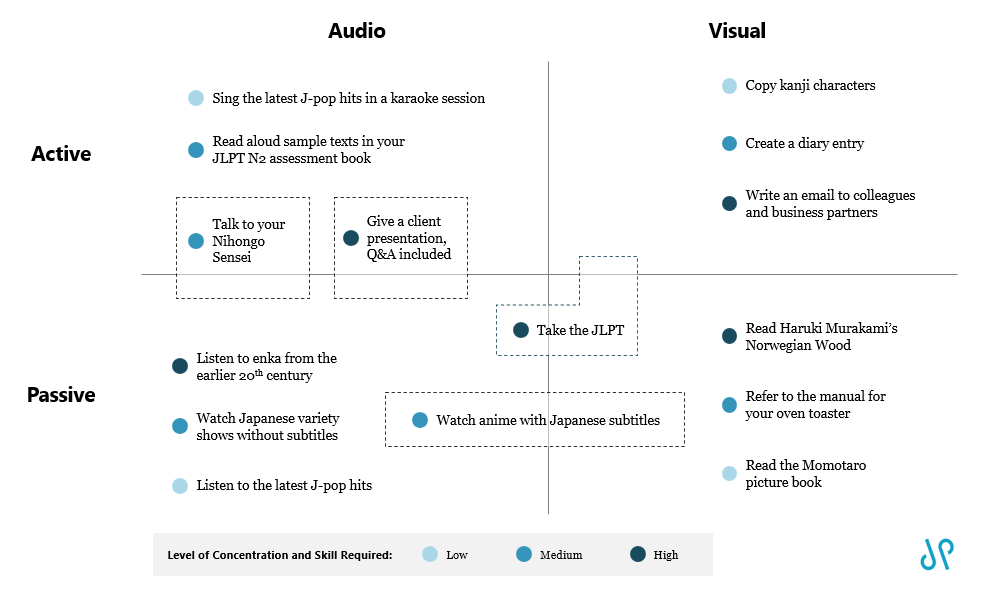
The list of language learning activities go on (see above for a completely non-exhaustive matrix). What’s important is to ensure that you partake in activities across all four quadrants and range of concentration and skill requirement. The balance is important, and not just in the audio and visual aspects. Focusing on only passive activities means that however much you can understand of the art and culture, you will remain an onlooker at best. On the flipside, a single-minded focus on speaking and writing may hinder your interactions with others to nothing more than the most rudimentary of exchanges: “how are you / I’m fine / thank you”.
One would think that focusing only on activities that require a high level of concentration and skill would be sufficient and be the most efficient in foreign language acquisition. From personal experience, I learnt the hard way that that’s not neccesarily the case. The prospect of entering the corporate world as mute, deaf and illiterate was scary enough for me to spend hours a day for months on end plunged in intensive Japanese study. I was drowning but I did not know it then. Through this linguistic equivalent of waterboarding, Japanese became more a cause for fear than felicity.
It’s okay (and arguably better for both language immersion and mental health) to take many breaks and to incorporate and enjoy low-effort activities too. Since coming here, I’ve included Japanese songs in my karaoke repertoire, where the joy of singing along takes precedence over the deciphering the semantics of the lyrics. Write simple thank-you notes. Strike those “how are you” conversations with neighbours. Assist a helpless looking tourist with directions.
These activities may be low concentration / skill / effort. But they are also the ones most prevalent in our daily lives. And the ones which embody the main purpose of language: for us to communicate and connect.
3. Manage your expectations (and be okay with imperfection)
Learning a foreign language especially as an adult is not easy. You are not going to improve magically overnight. You may not see significant progress even after many months. At this point, you may very well resign yourself to being functionally deaf, mute and illiterate in the foreign language.
It does not have to be this way though. Based on my observations of an inordinately small sample size, there are three main reasons why people fail to meaningfully pick up a foreign language.
- Lack of Interest (how badly do you want to pick up the foreign language)
- Lack of Immersion (includes learning resources, duration and consistency of time spent etc.)
- Inhibition
It’s the last reason that stands out. In my previous workplace, I was surrounded by ambitious, smart and young local colleagues, many of whom had graduated from top local schools, Todai (University of Tokyo) included. Yet in spite of their intelligence and high test scores, some of my ex-colleagues were essentially incapable of speaking in English. Dressed sharply in form-fitting tailored suits topped with a carefully crafted pompadour, they appear as the epitome of corporate professionalism. However, more often than not, their trepidation about not being able to speak English well engenders the very paralysis that almost guarantees that they will not speak it well.
To me, being prepared to make mistakes, and being just as prepared to learn from your mistakes quickly is perhaps the most underrated skill in foreign language acquisition. In my case, I faced the unsavory choice of being mute and useless the whole time or getting quizzical looks from my co-workers as I painstakingly try to piece together my ideas coherently. As the Japanese would say, it’s a situation of 板挟み (stuck between a rock and a hard place).
Life is the sum of your choices.
Albert Camus
Day after day, I chose to stumble. But with each stumble, the right terms became easier to summon. It became easier to place the verb at the end of a phrase. It became easier to read, write, listen, speak…and dare I say, think in Japanese. The attention I got from my colleagues gradually morphed from a quiet condescension to genuine attentiveness.
My grasp of the language is still far from perfect and there are days where I garble mid-sentence. And still too many times when my peers would catch me flipping through the Japanese-English dictionary on my phone during a nomikai (drinking party) to check the meaning of new terms and colloquialisms. Or watch me stare blankly at them as I try to figure out what was going on.
Then there was also a day where I could look at a top Japanese executive of a billion-dollar corporation in the eye and explain a technicality which he was curious about. The explanation was stilted and would not hurt from the use of more honorific expressions. But the point was clear.
The subtle nod of his head affirmed not just his understanding; it also affirmed the choices I have been making on this Japanese language learning journey. More so than any exuberant expressions of Nihongo ga jozu desu ne.
If you like this content, please like and leave a comment below.
Thank you for reading!
 Jin Pang