Consulting Research and Google Senpai

When I first started out in consulting, I was usually tasked with conducting research. In a firm where native English speakers comprised of less than 1% of the total employee population, my command of the global business lingua franca stood out.

Occasionally, this entails conducting interviews costing upwards of US$1,000/hour to gather insights from industry veterans with decades of experience as a first-year analyst. One of my more harrowing experiences include reacting professionally in real-time to a German energy expert as he elaborated on the intricacies of VDE specifications and the policy decisions underpinning them over a phone call. All while my Japanese speaking-only manager looked helplessly at me while stealing quick glances at his watch. The only person who seemed blithely unaware of the time was the energy expert whose enthusiasm for the subject matter and extended compensation could not be told apart.

Most of the times however, research is a much less expensive affair that centers around entering search terms into Google. As much as my peers and I like to joke that we are paid to just Google (and create pretty powerpoint slides), timely and relevant consulting research is a lot more than that. Even though it is treated as a “basic” skill and often relegated to entry-level staff, doing it well requires the mastery of more sophisticated skills.

What is unfortunate is that this skill may not be well-imparted by seniors and managers who are busy fighting their own fires. The result for the poor first-year analyst is pent-up frustration spending needless hours of overtime trawling the web mindlessly for a usable statistical nugget which may or may not exist.

This is what I wish I could have told that first-year analyst.

1. Plan
Before blindly accepting a request to “provide an estimate for the size of XX industry”, or “create a list of top trends that competitors are capitalizing on”, always ask the manager what his/her hypothesis is and what the basis, if any, for coming up with that hypothesis is. Doing so would help you to understand how the research you will be doing can directly support that hypothesis. Not only does that give you a greater sense of purpose to your work, you will also be able to expand your search to include other types of research that can support the hypothesis.

In the course of research, it is always vital to remember who the stakeholders are. Even if the manager explicitly mentions that the research “is not meant to be seen” by the client, the findings (if useful) would eventually be adapted and appear in front of the client in some form. To that end, it is also important to acquire a good grasp of who the client actually is. “Client” is not just an amorphous concept; it refers to actual human beings with their own agenda and proclivities. Your research should always consider not just the direct stakeholder – your manager – but also the end stakeholders – the client. This helps to ensure that the research you do will be relevant to all the people who will be consuming it.

Before entering clicking on that search bar, understand exactly what kind of information you want to collect. If you are planning to collate the research on an Excel spreadsheet, this would mean figuring out what are the fields that you would have and what kind of information you are expecting to populate it with. They range from the factual and simple (“Country : Japan”) to inferential and complex (“Highly likely that Company A is planning such and such due to…”). This preparation will accelerate your work as you can target your search by simply focusing on filling up that spreadsheet based on whatever you can find on the web. Without creating a target beforehand, it is often easy to succumb to link surfing and ride on wave after wave of information that bring you no closer to your goal.

2. Prioritize
Now that your planning is done, it’s time to start relying on Google senpai. To that end, it may be a good idea to prioritize and allocate time to specific search terms. The amount of time your manager gives you to research is highly limited but the amount of content out there is not. Allocate that time to each segment of that research. Chances are, the segments may not be equal. For example, if you are planning to do a deep dive for 3 companies and are given 3 hours to do so, it may be wise to start with Company A (if it is a priority – e.g. has the biggest market share) and allocate it 1.5 hours. The extra time allocated here is to account for learning. After you have created precedence in the form of Company A, it would be much smoother to proceed to Company B and C.

On the world wide web, not all search results are made equal. In your research, you would do well to prioritize the ones that are more important and apply the CRAAP test, designed by Sarah Blakeslee at California State University-Chico in 2004:

  • Currency: Timeliness of the info
  • Relevance: How the info fits your needs
  • Authority: The source of the info
  • Accuracy: Reliability and correctness of the info
  • Purpose: The reason the info exists

Of the five criteria, Currency and Authority are amongst the easiest to apply at first glance. Specifically, Authority can serve as a good proxy for Accuracy and Purpose. At risk of sounding biased, Gartner is a convenient example in this regard. Known as a leading IT market research advisory, it sources its information from well-connected research analysts and is incentivized to produce high-quality research that it charges per subscription. Quoting Gartner research can take a consultant very far based on my experiences inside and outside of the paywall. But the final and perhaps most important test is still Relevance (touched on later).

Unless you are adept as a speed reader, it is unwise to scrutinize every word in every link that you click. In conducting research, visuals and “Crtl-F” are your best friends. The human brain processes visuals 60,000 times faster than text. The essence of a concept or of the entire article is usually contained within a visual and it is usually far more expeditious to fully understand that visual, be it a graph or schema, than to pore through all the text. In cases where the article is wall after wall of text, it is may be a good idea to do a first cut by reading only excerpts which contain your search term(s). Should an excerpt prove exceptionally interesting, proceed to read the surrounding text to glean for insights.

3. Present
After all that hard work that you have put into planning and prioritizing your research, it would be remiss of you (I would go as far as to call it an injustice), if this was not properly communicated to the stakeholders. Given that research tasks may come up with pressing deadlines, it may not be feasible or expected for you to come up with pretty slides. What is more important is that the research be presented in a structured manner and be easily-understandable. Should you have created a spreadsheet to collate your results beforehand, reusing the spreadsheet as the basis of explanation would often suffice. Other possible means of presentation could be a collection of bullet points on a word processing medium or a rudimentary schema on a sketching software.

Ultimately, the structure and ease of understanding of your work should seamlessly tie back to the original hypothesis and the mandate of the project. Your research should serve as the empirical foundation of whether the hypothesis is true or false, with bonus points for inspiring further discussion among your peers and fueling more hypotheses. In short, the presentation of your research findings should show how it is relevant to the project. It can be as simple as going “The reason why this finding matters is because it proves the hypothesis true and suggests that…[inserts new hypothesis]”. While this may not be expected of a first-year analyst, it is what you need to do well to go beyond being just someone who can type into a search bar and press enter.

While Google senpai traditionally referred to the search engine, in the future it could progressively refer to Google Bard, Google’s conversational GenAI chatbot and a contender to OpenAI’s more popular ChatGPT. Instead of search terms, whole questions can be input with well-formatted results spawned and integrated into productivity tools in seconds. For the same task, the first-year analyst would have to take hours to accomplish. Does this mean that the first-year analyst is no longer relevant?

I would look reassuringly into the frightened eyes of the first-year analyst and tell him that it’s not the case. These new fangled tools may be monopolizing the attention of the business world at the moment. But there will always be a place for the strategy consultant who can get to the heart of wicked problems and navigate the just-as-wicked political maelstroms at a client. And it all starts with knowing how to recognize and conduct good consulting research.

Terrace House

As far as icebreaker questions go, “where do you live” is one of the classics as the answer can reveal as much as it provokes while still being socially appropriate in most contexts. In my case, the answer: “A sharehouse in Itabashi-ku”, usually draws the following responses.

“You must have saved a lot of money right?”
“Ah, Iidabashi right?” (a much more centrally located area in Tokyo)
“How many people live in the sharehouse?”

The conversation then usually proceeds to an inordinately intimate (and sometimes graphic) discussion about what sharehouse living is like, the good the bad and the ugly. So much so that my newfound acquaintances don’t forget “the guy who live in the sharehouse in the sticks where [insert fairly incriminating events happen]”.

So here is a much blander version of the conversation, which I hope you will still remember anyway.

My first (and many others’ too) of a sharehouse came from the hit reality TV series Terrace House. In each season, three men and three women (all strangers from different walks of life) temporarily live in a tastefully furnished landed property, which may not necessarily be eponymous. There, they live together and some go on to date one another. It’s purportedly unscripted in the sense that there aren’t any outwardly staged events or forced pairings and the participants are free to live their lives. All while under the watchful eye of strategically-placed cameras in the house. Be that as it may, I found myself enchanted by breezy camaraderie that only the young, attractive and unjaded can have.

As far as advertisement for sharehouse living in Japan go, this takes the cake. Hitherto, I had considered living by myself in one of those shoebox (approximately 20m2, with all the amenities you need) apartments that are littered all over Tokyo. But with this new fantasy of being part of the main cast in my own rendition of Terrace House, I narrowed my search exclusively for sharehouses.

Plus, being a foreigner fresh out of university with no plans set in stone, there are other more pressing concerns that support the case for sharehouse living.

1. Save Money
Japan may be classified as a developed economy but it is also notorious for the relatively low salaries (and high taxes) that makes working in Japan a poor proposition for a graduate from Singapore. This is especially true for fresh graduates, even those applying to top local banks in such inflationary times. Mizuho, the nation’s third-largest bank, said it will boost monthly salaries for college graduates joining in April 2024 to ¥260,000 (S$2,360) a month, up from ¥205,000 currently. In comparison, a graduate joining DBS, Singapore’s largest bank, is said to offering around S$5,000 for its graduate program. This is before accounting for the higher taxes and miscellaneous charges in Japan, and the Central Provident Fund contribution requirement (an additional 20% on top of base salary), that employers in Singapore are obliged.

No matter the non-pecuniary reasons for coming here, I was not prepared to be asking my parents for an allowance as a working adult. While the monthly rent for a sharehouse may not be only 20% cheaper than studio apartments of similar condition in the same area, the initial costs are a lot lower. Placing a deposit of a month’s worth of rent is a common practice worldwide. That’s not enough in Japan however; most landlords of rental apartments traditionally require a payment of “key money” equivalent to a month or two’s worth of rent as well. And what is this “key money” – the common English translation of 礼金 (reikin) – you may enquire.

It is nothing but an extortion of additional rent, purportedly as a token of appreciation to the landlord for his/her kindness in leasing their property to you.

As a tenant, this is definitely a part of Japanese culture which I do not quite appreciate.

On top of that, there are also property agent fees, guarantor fees (yes, you need to pay an entity who is willing to guarantee your rent payments lest you abscond), fire insurance and change of lock fees. Altogether, you could be looking at 5 months’ worth of mostly-irrevocable rent payments even before you step foot into an empty apartment.

To fill the apartment with the comforts of modernity then calls for a couple more hundreds or thousands of dollars. Even before drawing my first month’s paycheck, I could already be down by more than half a year’s worth of salary.

A sharehouse, on the other hand, has much lower barriers to entry. The total initial costs – a deposit and a cleaning fee – amount to slightly more than half a month’s worth of rent. The private room which I contracted for comes with its own bed, desk, chair, open wardrobe and even a refrigerator. The unlimited use of shared facilities, ranging from all-in-one ovens to separate washing and drying machines, and amenities such as sofa and large-screen TV with a fully paid for NHK subscription, is also included.

In most cases as well, the rent for a sharehouse covers the tenant’s share of utility bills and weekly housekeeping. Notwithstanding the moral hazard that this creates, I must say that this arrangement has been very convenient for this introvert who gets to work from home.

So yes, I guess I can save a lot of money. Whether I do though is a whole separate matter altogether.

2. Stay Flexible
In Japan, most contracts come with a 2-year lease. Early termination normally requires at least a month’s notice and may result in a forfeit of the deposit. In the case of contract renewal, the tenant usually has to fork out another month’s worth of rent as a “renewal fee” as well as pay for another 2-year’s worth of fire insurance. On the bright side, rent increases are rare for residential properties (because on the not-so-bright-side, wages have not been rising enough for landlords to reasonably pass on rent hikes).

Sharehouse living comes with lesser commitment. At the point of signing, tenants are obliged to stay for at least 3 months, though I have had neighbors who stayed only for a month. The contract duration is only for 6 months, after which an offer of contract renewal comes. Termination of lease requires only a month’s notice with no penalties. For someone who wasn’t sure how long he wanted to stay in Itabashi-ku, or to be in Japan for that matter, the flexibility was invaluable. I am not in Iidabashi, but I easily could be.

Nowhere did this flexible felt more precious than in the dark days right after the breakout of the Covid-19 pandemic when it felt like the best thing to do was to run home. More than four years later, I am living in the same sharehouse albeit in a much sunnier room and in a much sunnier place. Much of it can be attributed to the new south-facing floor-to-ceiling balcony that I have compared to the north-facing cavity of a window in my previous room. Though some of it can be said to come from being able to say “hello” to your fellow housemates at a time of hunger for the human touch.

3. Say Hi
I am known amongst my friends for being a low-maintenance friend. But low maintenance does not mean no maintenance. In a UK-based study with more than 458,000 people held over 2006 – 2010, researchers found that compared with people whose family and friends visited them daily, the risk of premature death for those who lived alone and never had visits increased by 39%. I was in a foreign land where I knew no one (save a few ex-colleagues) and unless I wish for myself an early death, it would be best to start making friends and “visiting” them daily à la the study.

A sharehouse felt like the best place to start. Not everyone is predisposed to being amicable of course but most conversations start (and end) with a reciprocated konnichiwa, or hajimemashite if you’re a real stickler for tradition. From there, they extend to “what’s cooking?” / “any plans for the day?” and in the warm cocoon of a living room, a new friendship is hatched. Before the pandemic outlawed social interactions, we even had a potluck Christmas party. I could barely speak the language then – cue the bungled McDonald’s order – but at times the other foreigners would kindly translate. Under an artificial potted ficus tree, we exchanged gifts (all gifts to be worth ¥1,000 (S$10) or less) in a secret santa exchanged. The Ginza currry retort pouch is long gone, but the accompanying curry spoon I received is now the spoon I use for foods beyond curry.

The warmness lingers.

I could continue waxing lyrical about the interactions and other small acts of kindness. But there are reasons why the word “sharehouse” is just as likely to elicit concern and anxiety in no small measure. Having an occupant : shower cubicle ratio of 7:1 meant that during peak times (9 PM – 11PM), there is a high chance of having to wait for one’s turn. There have also been countless times when I deliberately leave the house to order take-out when the only kitchen in the house is crammed with other hungry housemates.

The inconvenience extends beyond resource use; one unwittingly witnesses the ugliness of people who do not truly understand and uphold the “share” in “sharehouse”. From clogged drains in the shower cubicles to loud phone conversations in the dead of the night. The worst part is when these offences repeat and go unpunished as appeals from reluctant management representatives go unheeded. The inconsideration rankles and the frustration stews.

Man is a creature that can get used to anything, and I think that is the best definition of him

Fyodor Dostoevsky

Gradually, one becomes inured to these perturbations and reconciles with another quintessential Japanese characteristic – 仕方ない (shikatanai) – which is a weary acceptance of things that one cannot change, or find that the costs to be incurred not worthy of the change that it engenders. Or in other words, one becomes more jaded. I guess am no longer the same starry-eyed boy who looked forward to starring in his own season of Terrace House.

In the show, the participants come and go. A couple of episodes later, once they have gotten a feel of communal living and fulfilled whatever purpose is it that they appeared in the show for, they leave. It’s the same in my sharehouse, and I genuinely feel happy for some of my housemates when they have moved on to the next step in their lives. A sharehouse is a stopover, not a destination.

And I’m looking forward to graduating from Terrace House someday too.

Nihongo ga jozu desu ne

For the uninitiated, that phrase above is a transliteration of 「日本語が上手ですね」which means “Your Japanese is really good”. Said (too) often by native Japanese folks to foreigners who are noticeably trying very hard to get the right words out in the right order. Normally in a conversation about the weather and other small pleasantries.

It’s intended as a compliment but may inadvertently come across as patronizing. This feeling is not foreign to a Singaporean of Chinese ethnicity who has travelled abroad and been told on no few occasions that “Your English is very good [for a Singaporean]”. I mean, English is the main language we use in the little red dot, though not everyone can slip in and out of the Singlish accent and mindset easily. It is only when someone says that my “Chinese is very good” that I truly blush a little.

But I digress. For this is a story of how I went from flubbing a burger order at McDonald’s to chiming in at a high-stakes client presentation in four years. And how your nihongo [Japanese] can be really jozu [good], explicit external validation not necessary.

It was September 2019 and I have just touched down at Narita Airport to go to seek my great perhaps. Exactly a year earlier, I was given an offer by my previous firm to return as a fresh graduate analyst, only now that speaking business Japanese “is expected”. For someone whose command of the language amounted to whatever was contained in the Genki I textbook, it was a tall order to say the least.

But if they believed in me enough to offer, surely I would be courageous enough to accept it. Plus I was curious: what would it be like to be a tabula rasa once more, as fresh graduates in Japan are expected to be anyway? In Singapore, I had hewed very closely to the archetypical aspiring Singaporean corporate professional path. This may sound audacious but I could see, even know how my life would turn out if I didn’t rock the boat.

So I rocked the boat.

It’s not as if I didn’t come prepared though. In that final year in university, I spent more time poring over Japanese textbooks and assessment books than on the tutorials that were supposed to help me graduate. All that cramming for the Ten Year Series from my primary school to junior college days did not go to waste. Within a year, I was able to clinch a passing grade for the N2 (second-highest level) for the Japanese Language Proficiency Test (JLPT).

In short, I should have been able to comprehend orally presented materials such as coherent conversations and news reports, spoken at nearly natural speed in everyday situations as well as in a variety of settings, and is able to follow their ideas and comprehend their contents [sic].

So with my (un)warranted confidence, I stepped into a McDonald’s to order my go-to, a fillet-o-fish burger a la carte. It is as simple as most orders go. What could go wrong?

「店内で食べますか?それとも持ち帰りますか?」(Dine here or to go?)

I was stumped. Apparently, my faculties for listening comprehension were only activated when I am seated with a test booklet in front of me and surrounded by other acolytes in similar postures. In the austere and quiet sanctuary of an examination room no less, of which a McDonald’s in Shibuya certainly was not.

After a few more weak-willed requests for the cashier to repeat, and even weaker-willed attempts at understanding, I retreated to clarifying in English what was being asked.

Surrounded by the growing impatience of both the cashier and snaking queue behind, my choice was clear.

So that nobody here has to duck out of McDonald’s prematurely again out of linguistic shame, here are three lessons that I learned in this journey.

1. Master the basics (which really aren’t that basic)
It sounds so simple but it is a lot harder, and requires much more discipline to accomplish in practice. In my valiant attempt to be at the “business-level” in the language, I pummelled through successive levels of the JLPT. Instead of starting from N5, the most basic JLPT level, I challenged myself to complete the N3 (Intermediate) in a few months with nary a foundation to stand on. To compensate for the lack of years of studying in a language school that one would normally need for this level, I shortcuited the process by reviewing my grammar notes repeatedly.

For me, the crux lay in the grammar because without which, I could not tackle the vocabulary and reading comprehension sections too. Without good grasp in grammar, one cannot expect to understand the relationship between terms. I could get by without mastering all the vocabulary as some of the kanji terms were the same as those in Chinese. Listening comprehension was pretty much a toss of the dice since there are only three options to choose from for each question. And one only needed 19/60 for each section to pass (subject to a minimum cumulative score). Thereafter, bulldoze through practice papers after practice papers to increase my familiarity with the test structure. The content of the questions may change, but not their presentation will not.

It was with this calculation that I sought to “game” the test, not just for the N3 but also for the N2, which I took six months after. But Japanese is not just a test subject; it’s also the 8th most spoken language in the world. And it has the complexity of one where its native speakers are amonst the most literate globally. It was indeed misguided of me to think that a year of hard studying and not much else would be enough to be at the business level; it may not even be enough for ordering at McDonald’s.

What did help me approach that level in my years here was going back to the basics. Even with the “N2 Pass” under my belt, it was the Genki I textbook that remained my constant companion. Before tackling the esoteric あるまじき, it is crucial to understand が、を、に、で and は and the essence of what they mean. The former may be fancy but its use is highly regulated and specific. On the other hand, the common Japanese particles are often combined and deployed in myriad ways, many which may not be gramatically correct, but which feature in the paraphernalia of everyday life.

Plus, I would also recommend close reading of any tourist guidebook containing common phrases to avoid embarrassment at food and retail establishments.

2. Maximize your exposure (to the language)
Cramming grammar rules and tearing through mock tests could be effective if the purpose is to pass a test. It is much less so if the purpose is to assimilate a foreign language and culture. Japanese was not something which I wanted to memorize and regurgitate for an examination; I wanted it to be a means to understand and be understood in this new world.

Early on, I decided to engage with community tutors on iTalki, an online language learning platform which connects language tutors and students. There was also an option to choose professional tutors but this was never something which my then-student budget entertained. Besides, my main purpose was to talk to someone native, in as natural a setting as possible. And for that someone to probe me to speak in Japanese. To this day, I still shudder when I recall the initial struggle to string words and particles in my head, especially when it comes to placing and conjugating the verb at the end. You never know what someone means until the very last utterance.

Watching anime used to be an enjoyable pastime, but it became listening and reading practice when I switched the subtitles from English to Japanese. Instead of admiring the vibrant interplay of colors and lines flooding the screen, my eyes were glued to the monochrome mix of kanji and kana. Pausing and rewinding every few moments to check the dictionary does detract from my viewing pleasure. But at least now I can justify spending more time bingeing on the latest Netflix series in the name of productivity. Looks like you can’t take Singapore out of the Singaporean.

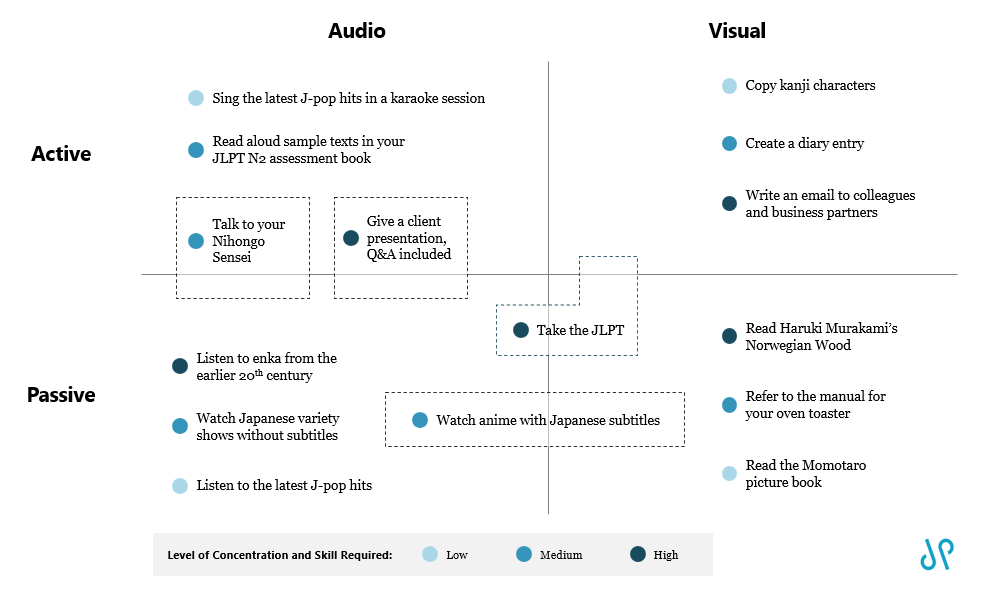
The list of language learning activities go on (see above for a completely non-exhaustive matrix). What’s important is to ensure that you partake in activities across all four quadrants and range of concentration and skill requirement. The balance is important, and not just in the audio and visual aspects. Focusing on only passive activities means that however much you can understand of the art and culture, you will remain an onlooker at best. On the flipside, a single-minded focus on speaking and writing may hinder your interactions with others to nothing more than the most rudimentary of exchanges: “how are you / I’m fine / thank you”.

One would think that focusing only on activities that require a high level of concentration and skill would be sufficient and be the most efficient in foreign language acquisition. From personal experience, I learnt the hard way that that’s not neccesarily the case. The prospect of entering the corporate world as mute, deaf and illiterate was scary enough for me to spend hours a day for months on end plunged in intensive Japanese study. I was drowning but I did not know it then. Through this linguistic equivalent of waterboarding, Japanese became more a cause for fear than felicity.

It’s okay (and arguably better for both language immersion and mental health) to take many breaks and to incorporate and enjoy low-effort activities too. Since coming here, I’ve included Japanese songs in my karaoke repertoire, where the joy of singing along takes precedence over the deciphering the semantics of the lyrics. Write simple thank-you notes. Strike those “how are you” conversations with neighbours. Assist a helpless looking tourist with directions.

These activities may be low concentration / skill / effort. But they are also the ones most prevalent in our daily lives. And the ones which embody the main purpose of language: for us to communicate and connect.

3. Manage your expectations (and be okay with imperfection)
Learning a foreign language especially as an adult is not easy. You are not going to improve magically overnight. You may not see significant progress even after many months. At this point, you may very well resign yourself to being functionally deaf, mute and illiterate in the foreign language.

It does not have to be this way though. Based on my observations of an inordinately small sample size, there are three main reasons why people fail to meaningfully pick up a foreign language.

  1. Lack of Interest (how badly do you want to pick up the foreign language)
  2. Lack of Immersion (includes learning resources, duration and consistency of time spent etc.)
  3. Inhibition

It’s the last reason that stands out. In my previous workplace, I was surrounded by ambitious, smart and young local colleagues, many of whom had graduated from top local schools, Todai (University of Tokyo) included. Yet in spite of their intelligence and high test scores, some of my ex-colleagues were essentially incapable of speaking in English. Dressed sharply in form-fitting tailored suits topped with a carefully crafted pompadour, they appear as the epitome of corporate professionalism. However, more often than not, their trepidation about not being able to speak English well engenders the very paralysis that almost guarantees that they will not speak it well.

To me, being prepared to make mistakes, and being just as prepared to learn from your mistakes quickly is perhaps the most underrated skill in foreign language acquisition. In my case, I faced the unsavory choice of being mute and useless the whole time or getting quizzical looks from my co-workers as I painstakingly try to piece together my ideas coherently. As the Japanese would say, it’s a situation of 板挟み (stuck between a rock and a hard place).

Life is the sum of your choices.

Albert Camus

Day after day, I chose to stumble. But with each stumble, the right terms became easier to summon. It became easier to place the verb at the end of a phrase. It became easier to read, write, listen, speak…and dare I say, think in Japanese. The attention I got from my colleagues gradually morphed from a quiet condescension to genuine attentiveness.

My grasp of the language is still far from perfect and there are days where I garble mid-sentence. And still too many times when my peers would catch me flipping through the Japanese-English dictionary on my phone during a nomikai (drinking party) to check the meaning of new terms and colloquialisms. Or watch me stare blankly at them as I try to figure out what was going on.

Then there was also a day where I could look at a top Japanese executive of a billion-dollar corporation in the eye and explain a technicality which he was curious about. The explanation was stilted and would not hurt from the use of more honorific expressions. But the point was clear.

The subtle nod of his head affirmed not just his understanding; it also affirmed the choices I have been making on this Japanese language learning journey. More so than any exuberant expressions of Nihongo ga jozu desu ne.


If you like this content, please like and leave a comment below.

Thank you for reading!

101 Things I learned in Architecture School

This sharing was first published on LinkedIn on 28 December 2023. I was in a particularly reflective mood having just spent a full four years in Japan and also having had the most productive year in my life thus far as a consultant.

I would highly recommend picking up Matthew Frederick’s 101 Things I learned in Architecture School” for just about anyone interested in knowing what makes our buildings not just beautiful but also meaningful.

One thing I do like about the work I do is that I am always challenged to learn something new and apply it for the client’s best interests. It’s what keeps both my clients and me engaged.

But on a Saturday two weeks ago, I was in a cafe when I chanced upon a book that had nothing to do with IT or Strategy. It was a little book about Architecture, specifically the 101 things Matthew Frederick learnt in school.

And though tips like knowing how to best roll drawings for transportation or storage are not immediately relevant, there are quite a few other takeaways. Especially at this time of the year, when one can’t help but reflect on the how the year has passed and to look forward to the year ahead.

So here are just 3 simple parallels I’d like to share between consulting, as I have experienced it to date, and architecture, as distilled in this book.

1. Parti.
This is a term referring to the central idea or concept of a building, and is usually expressed as a diagram representing the general floor plan. It is usually of non-architectural origin and informs the form of the building. When creating slides to best convey complex concepts, there is always that temptation to create something fancy and to cram details into the landscape. But my best work usually come from always nailing down the key points and understanding how they are related. Ideally in a single, unified way. And this book taught me that there is already a term for this.

2. Specificity.
The more specific a design idea, the more attractive it will likely be. Some of the most awe-striking architecture we see are deeply imbued with their purpose, symbolism and background. At Gartner, I do have the privilege of having access to the most cutting edge market research and trends in IT around the world. And while this is indeed valuable, what truly makes a difference is when this research serves as an input amongst others, elevated through rigorous analysis. When a client, who may not have the know-how or experience, is able to comprehend why this research matters specifically to them and not all the other players, that’s when I know I’ve done my work.

3. Generalist.
An architect knows something about everything; an engineer knows everything about one thing. There have been too many times when I feel inadequate because I do not feel like I know enough in a subject matter compared to colleagues who have spent years honing in that area. But the thing is, in most of my roles to-date and in this career stage, a consultant is more akin to an architect than an engineer. One just has to know enough of each discipline, and be willing to learn and reach out to resources that know enough to honor the needs of the client.

The coffee was cold by the time I was done, but these musings did leave me warm inside.

Wishing everyone a great year ahead.

The Origin Story

This story was written in October 2019 on LinkedIn as an entry for a writing competition organized by someone I knew from school.

It has been weighing on me for quite some time to get back to writing for a general audience. And I cannot think of a more appropriate piece to inaugurate this blog than with one which was written in those relatively halcyon days.

Before the COVID-19 pandemic brought the world to its heels.

Before I took off the rose-tinted glasses that a foreigner inevitably wears to Japan at the start.

Before I started appreciating my time here and this place as what it is rather than what I thought it was.

“Are you sure that you didn’t get someone else to do up your online test for you?”

It was 4 a.m. in Philadelphia and I was dressed in a business shirt and track pants while being interviewed for a summer internship at BayCurrent Consulting, one of the largest general consulting firms in Japan. I was sluggish in tackling the math and case questions being hurled my way through Skype by my Singapore-based interviewer and it showed.

Truth be told, I was more appalled by the attack on my integrity rather than my intelligence with the lack of empathy ranking somewhere in between. In response, I apologised, clarified that my online test was truly my work and pointed out that it was still darkest before dawn where I was.

Thankfully, dawn came in time and I soon found myself a 3-full-week long internship (technically 18 working days) in Tokyo in the August of 2018.

I had three mentors whom I remember fondly from my internship days, all whom spoke fluent Japanese. The first was an ethnic Korean Australian. She was patient, stoical and brutally frank. I have lost count of the number of times I was chided for 1) not clarifying the requirements of the task before proceeding 2) using fanciful English which impeded understanding and 3) giving too many excuses. Yet she still made it a point to set aside an hour a day poring through my work with me, nudging me towards an insightful response each time and stressing the importance of formatting and presentability in everything that I offer as completed work.

The next was a US-educated Chinese. He was approachable, kind and responsible. I was assigned to his team to help with some research in my final week. I would have understood if he saw me as a temporary worker to be exploited and threw me the most mundane of tasks with little guidance. Instead, he treated me as a full member in his team and I was tasked with research that would eventually be presented to the client. Along the way, he gave me tips and tricks for being a more efficient and effective consultant and encouraged me to develop my own interpretation to the data.

The last was a fellow Singaporean. He was eloquent, generous and seemingly mercurial. On my very first day, I drank from a consulting fire hose he nonchalantly held. In subsequent days, I racked my brains to come up with data and syntheses within time constraints that felt impossible at times. At work, his standards were exacting, and he would not accept compromise. After work, he did a 180 and became a buddy. From him, I learnt that we each must make our own choices in separating work and play. But more importantly, I know now that a life without a hypothesis is not a life well-lived.

I embarked on the internship thinking that it would be a fun and enriching experience with no lasting consequences. After all, I could barely speak enough Japanese to get around the city, let alone engage in business discussions. The internship was supposed to be a serendipitous once-off occurrence which I could cherish as a memory. But I could not forget the excitement I felt during those interviews, the inspiration I felt from my mentors and the vibrancy of the city. And the three lessons of this unforgettable experience in my forgettable life.

First, we must recognise that our achievements are almost never only due to our merits. At first glance, it may seem that my grades and exhibited abilities got me through the door. But that would only be a very small part of the story. BayCurrent Consulting was actively looking for Singaporean interns in late 2017, motivated surely by the performance of our local universities in global rankings and the reputation of our people. Singapore was a brand that they could trust, and this was corroborated by the track record set by my pioneering Singaporean mentor. It was on the shoulders of these institutions and precedents that I stood that gave me the stature to reach for this opportunity. So now it is my turn to help pave the way for those who will come after me.  

Next, we must connect with one another. Nothing adds a feather to our career cap like an overseas work experience. It exudes desirability, intrepidity and adaptability in a resume for the most part. And of course, you get to tick off your fair share of tourist attractions while you’re in the area as well. But what I remember most from my time in Tokyo and other overseas stints which I’ve had the privilege to embark on are the connections, however fleeting, that I’ve made with people from diversely different backgrounds. A weekday lunch with an American colleague at an izakaya near the office. A weekend day trip to Kamakura with a fellow Chinese intern. A farewell dinner with Japanese supervisors. I may no longer be actively in contact with most of them but during the intersections where our paths crossed, we had more that we shared than otherwise.

Finally, we must each come up with the hypothesis to our lives. As Singaporeans, most of us grew up knowing (and needing to know) what our paths in life would be. It was a path that also came embedded with an implicit promise: study hard in school, get good grades and you will be able to finance a materially comfortable existence for you and your loved ones. You will be able to live the good life. The hypothesis is a foregone conclusion. Perhaps more than most others, I bought into that promise and certainty and I devoted most of my time and effort into my academics. For the most part I did well in school but as the years rolled by, I felt increasingly dissatisfied. I was studying with no direction and as thankful as I am for the support I had received for this journey, it did not feel like a journey which I had any agency in. But this couldn’t be any further from the truth. We have the freedom to choose; we just need to accept whatever consequences that stem from these choices, including consequences that we could never have imagined beforehand.

That is when given the opportunity to return, I seized it. And I haven’t looked back since.


Notes:

  • I was in Philadelphia as an exchange student when the intern recruiment process was ongoing and was thus unable to be interviewed in-person.
  • There was no requirement to speak Japanese for the internship; it was a different matter for the full-time offer as a graduate analyst and I was expected to speak business-level Japanese upon joining BayCurrent Consulting. That’s a different story for a different day.